Charley the Monkey

Monkey Memories

Charley the Monkey
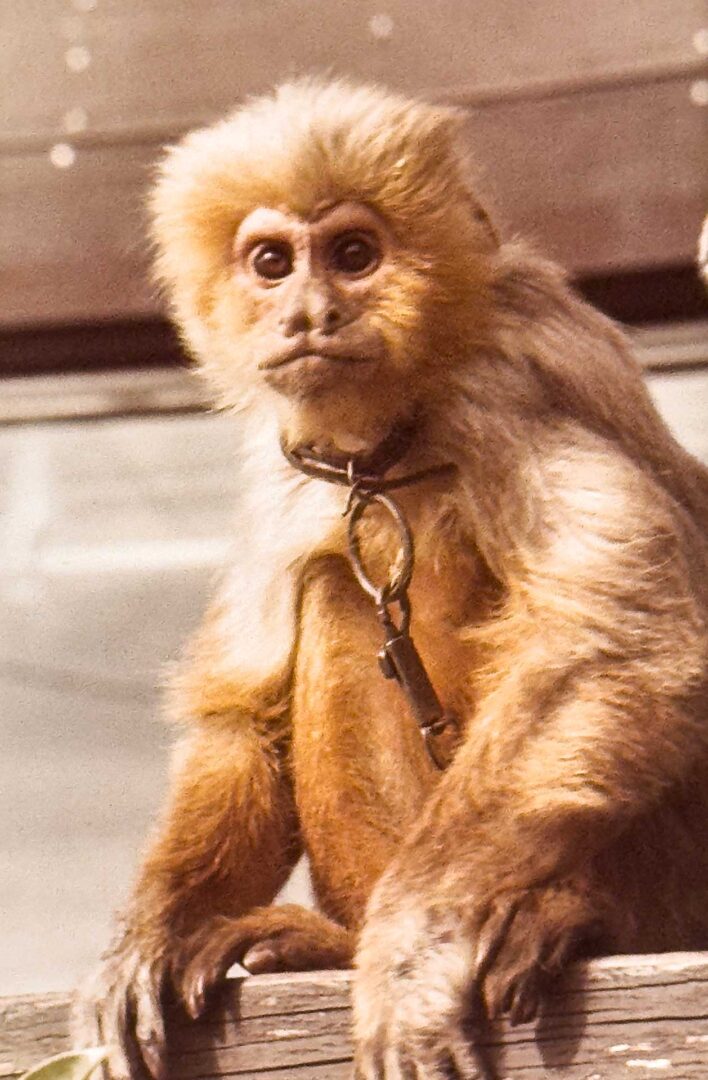
A photograph of Charley, a member of the Wong family for over 30 years

One morning, before my day in 5th or 6th grade at Crocker Highlands School, I was in the kitchen getting something to eat. I heard a noise in the downstairs water closet. The small room had only a toilet and a single window eight feet above the floor that opened to the garage roof. When I opened the door, I saw a light tan colored tail, curled and sticking out from behind the toilet. It was attached to a monkey.

My parents were still in their bedroom when I went to tell them. They called the”Oakland pound” (Oakland Animal Services). The “pound” came out and picked up the monkey to quarantine it, and three weeks later, they said, it’s yours. Somehow, my parents agreed to have a fifth member join the family, and we named him Charley.

I have a faint recollection of seeing a monkey on our clothesline a few days before. Our backyard had a lot of fruit trees: pear, loquat, orange, apple and lemon trees. There were also blackberries, wild strawberries. Maybe that’s why Charley was hanging around our house. But we never found where Charley came from. When we found him, he was very young, had a gash on his leg and no collar.

In the early 60s, monkeys were sold in pet stores. We went to a pet shop on Fruitvale Avenue in the Dimond District of Oakland and bought a cage and a book – “Monkey Business,” by Gus and Casey Augspurg.

The cage that we put in the basement was about 4’x3’x3’ . At first, during the day, we kept Charley outside in the front yard with his leash attached to a spiral tie out stake. He could jump up and climb on the magnolia tree. At night, Charley would sleep in his cage in the basement and in the morning, he would let us know that he was awake by shaking his cage.
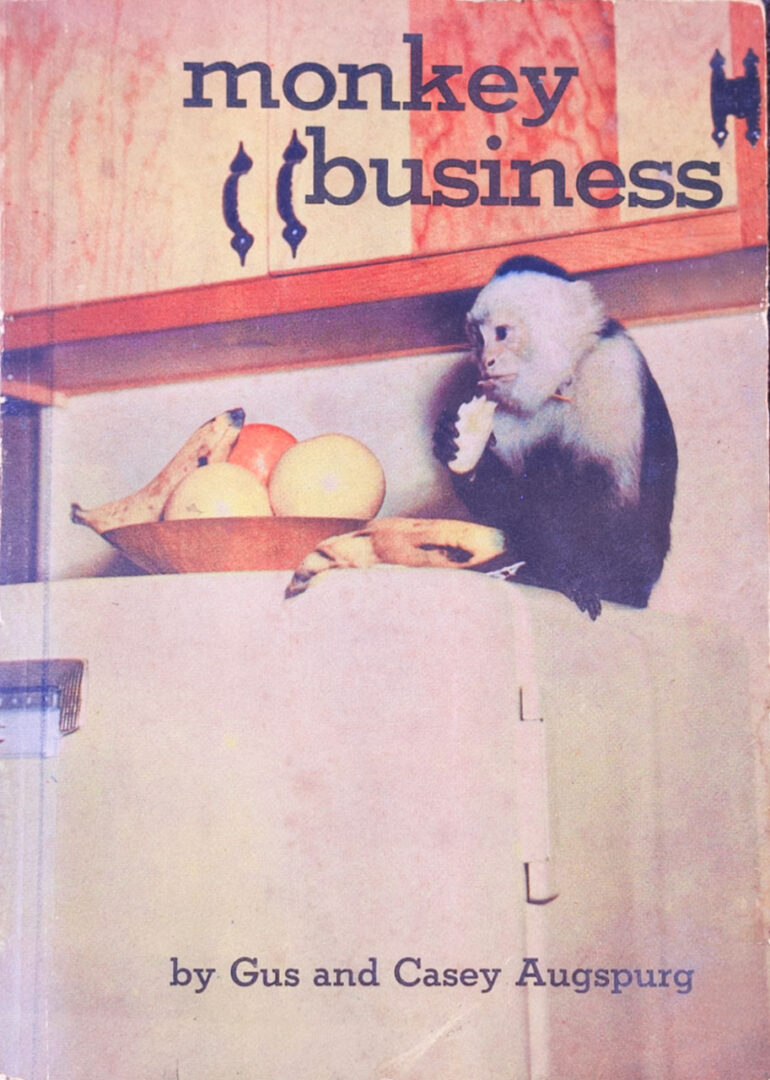
A photograph of the cover of the book, “Monkey Business” by Gus and Casey Augspurg.

Charlie’s canine teeth were sharp. Once, when he bit the middle finger on my right hand, I instinctively pulled my hand away and caused a laceration. I still have scars on my hand from Charlie’s bites.

When he bit a kid, Charlie moved into a big cage. My Mom got a cage from one of her bridge player friends who had something to do with Children’s Fairyland. It was a big cage on casters, maybe 6’x5’x4’ with a bar at the top for a perch, and a rope hanging down the middle for swinging.

Our morning routine was the give Charley some milk to drink, about two or three ounces, warmed up in an old pill bottle. My dad (an accountant) used to get produce from one of the supermarkets that was one of his clients. Charlie ate lettuce, carrots, nuts, fruit, insects and an occasional raw egg. Besides those things, we started feeding him food that we ate. We’d put some cooked rice in a cupcake baking cup with whatever protein our dinner had: a shrimp, a little piece of beef.

Most of the time, my dad took Charley inside to his basement cage at night. They’d sit on the front porch for a while as my dad smoked a cigar before going down to the basement.

Once Charley got out of his cage and ran down the street. He climbed a tree in front of the Duhe’s. I ran down the street after him and when I called him, he came right down to me.

So we could take Charlie on vacation with us, Dad bought a 1964 Ford Fairlane 500 Ranch Wagon. It was Wimbledon white with a 289. (I later probably cracked the engine block on a trip to LA with Bruce Baxley, by pouring cold water into an overheating engine). I remember one trip to Monterey. My dad had a friend that owned the Casa Carmelkorn store on Fisherman’s Wharf. Our family would drive down from Oakland and stay at the Borg’s Motel. Charley slept in a cage in the car.
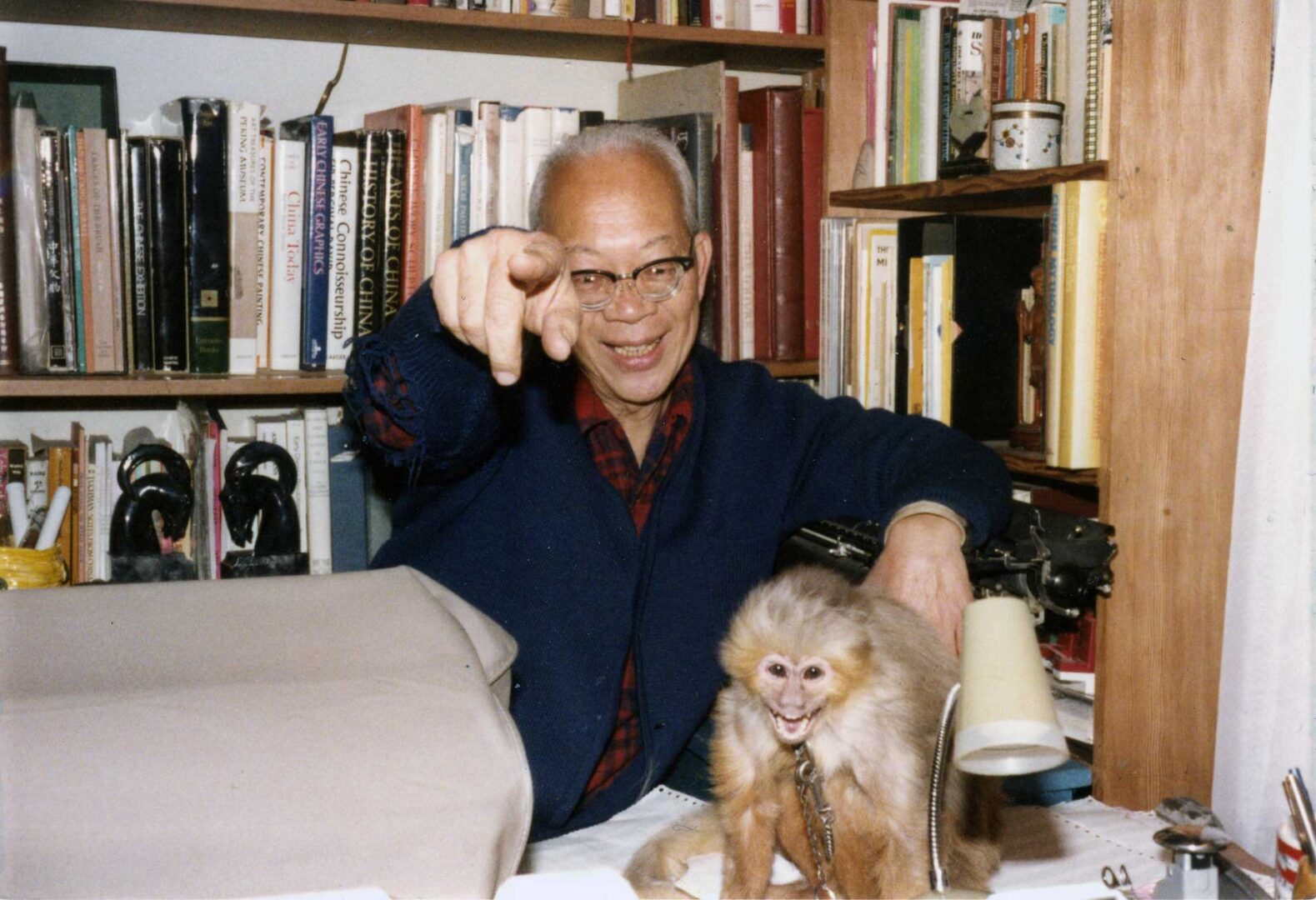
Honki L Wong and Charley the Monkey
Honki L Wong (dad) and Charley in my dad’s office; Charley is not smiling (from my sister’s (Alberta Mayo) Old Family Photos flickr album

Charley liked to draw. On the way to the basement, Dad and Charley would go through my Dad’s office. Dad had those large continuous form computer printouts and Charley would take a pen or pencil (after chewing on it a little) and scribble on the printouts. It seemed that Charley was aware that he was having an effect with his drawing.

We only had one telephone for the entire house. It had a long extension cord that reached almost to the top of the stairs to the second floor. My mom used to sit on the stairs talking to her friends in Chinese. (That’s how my ear became attuned to the Shanghai dialect, even though I can’t understand it) My mom would be on the phone with Charley on a leash. Charley would draw on the wall with a pencil.

After my dad died in 1980, it was just mom taking care of Charley. My sister, Alberta was living in Houston or Boise, and I was living in New York.

One time I came home from New York, Charley had a large tumor on his chest. My mom took him to the vet, and the tumor was removed. The vet said that Charley wasn’t getting enough fat in his diet. The vet said to feed him Purina High Protein Monkey Chow. Charley didn’t like it.

By the early 90’s, Charley had been in the family for almost 30 years. He was getting a little too difficult for my mom. She found a primate sanctuary (though I can find no record of it) near Davis, California that took Charley.

Knight Kit C-555 Walkie Talkies

When I was 10 or 11 years old in the early 1960s, one of my best friends, Scott Simonds, lived about 2,565 feet away from my house on Calmar Avenue. Scott lived Mandana Blvd, just below Ashmount Ave. That distance was significant because I thought that the Knight Kit C-555 Superhet Walkie Talkie Transceiver Kit would be a great way for Scott and I to keep in touch.

The 1964 Allied Radio catalog (page 2) said that the walkie talkies had a 3/4 mile (~1.2 km) operating range with their 100 mw input. (Currently in the U.S., FRS – Family Radio Service – has a 2 watt maximum)

C-555 Walkie Talkie Kit
Page 2 of the 1964 Allied Radio Catalog showing the Knight Kit C-555 Superhet Walkie Talkie Transceiver Kit

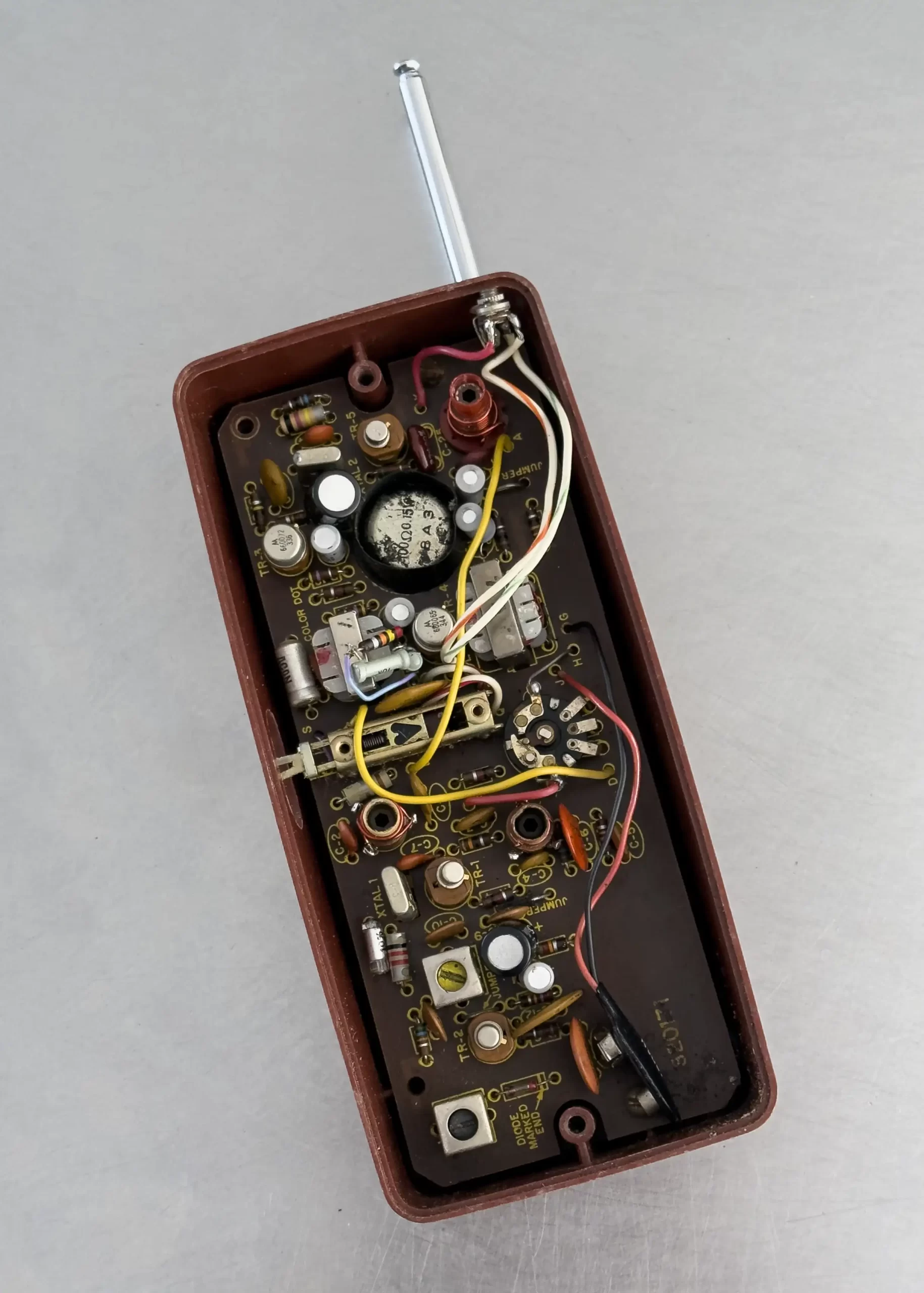
I thought that I could build the kit because, my father, for some reason, owned a Weller Junior Model 8100 Soldering Gun. After soldering the components to the circuit board, the walkie talkies didn’t work. Unfortunately, troubleshooting the kit was a little beyond the my capabilities when I was 11 years old. Fortunately, my Uncle Jimmy went through them and he got the C-555 walkie talkies talking to each other.

Knight Kit C-555 Superhet Walkie Talkie Transceiver Kit with rear cover removed showing electronic components
What my Knight Kit C-555 Superhet Walkie Talkie Transceiver Kit with rear cover removed showing electronic components looks like on May 17, 2025

One modification that I made was to replace the battery connectors with the common PP3 9V Battery Snap Connectors. The original design used a PP4 (Eveready 226, NEDA 1600) cylindrical 9V battery with a snap connector at each end. (see Joe Haupt’s flickr photo)

The ironic thing about this is that I don’t recall ever actually talking to Scott using these walkie talkies from my house to his.

For some reason, 61 years later, I still have both of these walkie talkies in my possession.

Lakeshore Ave, Oakland, California

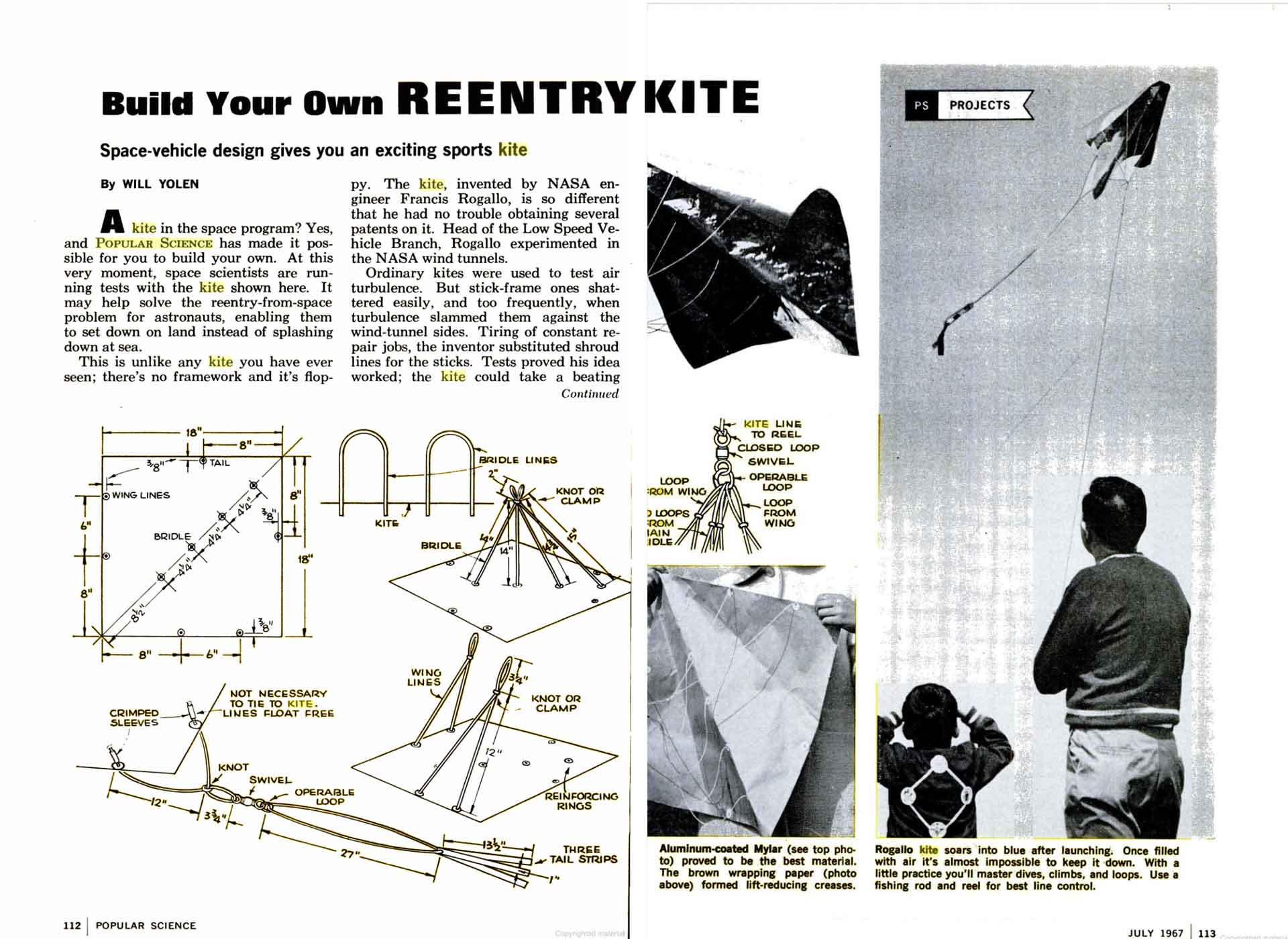
Plans from the July 1967 Popular Science Magazine for building your own Re-entry kite out of mylar.
Plans by Will Yolen. from the July 1967 Popular Science Magazine for building your own Re-entry kite out of mylar.

What does Lakeshore Avenue have to do with plans to build your own reentry kite? In the late 1960s, the Dime and Dollar store didn’t sell one of the materials needed to make it – biaxially oriented polyethylene terephthalate – mylar.

Lakeshore Avenue in Oakland, California, runs from the south end of Lake Merritt and ends a block from the house that I grew up in on Calmar Avenue. In the 1970s, Huey Newton lived at the south end at 1200 Lakeshore Avenue.

When I was a kid, going down to “Lakeshore” meant going to the commercial area between Mandana Boulevard and Lake Park Avenue. The main business that was my focus as a child and teen was the Dime and Dollar Store, which my family referred to as the “Dime Store.”

This Oakland Wiki entry pretty much sums up the Dime and Dollar Store for a kid growing up in the 1950s and 1960s:

“…they had pretty much everything…including fabrics and toys and lots of candy. They always had all those wax lips and mustaches and movie magazines. The lady with the black beehive would follow the kids all around the store. You could buy ‘caps’ too and squirt guns”

Candace Miller Blackman

In the late 1960’s, my Uncle Jimmy gave me a subscription to Popular Science. I’m pretty sure that Uncle Jimmy and that subscription launched me on a lifetime of making things.

The July 1967 issue of Popular Science Magazine had and article titled, “Build Your Own REENTRY KITE” It detailed a kite designed by NASA aeronautical engineer, Francis Rogallo, who was trying to solve the problem of space vehicle reentry on land, instead of water. Rogallo had invented what became known as the “Rogallo Wing”, the basis of the modern hang glider.

Space technology was fascinating to the 15 year old me, and the idea that I could build something using NASA technology made it even more so. The article suggested making the kite out of brown wrapping paper or aluminum coated mylar.

I went to the Dime Store and asked if they had any mylar. They didn’t know what it is was. I tried to describe it as a metallized plastic. That didn’t help.

Mylar (BoPET – biaxially oriented polyethylene terephthalate) was developed in the mid-1950s by Dupont and other chemical companies. NASA used mylar in a balloon, Echo 2, launched in 1964. Unfortunately, the technology had not yet trickled down the the Dime Store, so I built my kite out of brown wrapping paper.

Updating the Raspberry Pi Webcam

Update (January 25, 2021) My Raspberry Pi powered webcam is now showing the Jordan Park Neighborhood in San Francisco, California. The Raspberry Pi Model B, Rev 2 is using the Raspberry Pi High Quality Camera (with the Raspberry Pi HQ Camera Lens – 6mm Wide Angle) and is running Motion (pi_buster_motion_4.3.2-1_armhf). Details to follow.

(Original post) I built a streaming webcam showing the view from my downtown Oakland apartment in November 2012. I used a Raspberry Pi (Model B Revision 1.0) and the Raspian Wheezy (2012-10-28) image. For the webcam/web server software, I used MJPG-streamer. The problem with MJPG-streamer is that if the images/stream is available on the internet, then anyone can access the software.

Recently my Raspberry Pi began to lose the WiFi connection. In researching various solutions, I disabled WiFi power management on the Edimax EW-7811Un nano-size USB WiFi adapter. That didn’t solve the problem. I switched to Ethernet but the connection still dropped.

I found a nice script for “Rebooting the Raspberry Pi when it loses wireless connection“. It’s a script that runs in crontab and checks for a network connection by pinging a local address. If the ping fails, it restarts wlan0.

The checkwifi.sh script worked great, but then I had an issue with the video stream image oscillating. The image would continually go between light and dark and the only way to stop it was to restart MJPG-streamer.

I decided to update to the current Raspbian Jessie with Pixel and some other webcam software. The Motion-Project seemed not to difficult – I could use it as a streaming webcam. I decided to use Motion 4.0 and Kenneth Lavrsen’s Motion 4.0 Guide to help set it up. I don’t know if the image oscillation is an issue caused by using the Creative Live! Cam Chat HD (auto exposure?) but this current setup seems to have resolved the issue.