Should You Be An Engineer

In the late 1950s to the early 1960s, from kindergarten to the sixth grade, I was a student at Crocker Highlands Elementary School in Oakland,

The Oakland educators must have been forward looking, because I remember taking a Strong Vocational Interest test (Strong Vocational Interest Blank). I also received a bunch of small pamphlets distributed by the New York Life Insurance Company Career Information Service. (Link to Career opportunities; a series of articles designed to help guide our children to a better future on the Internet Archive) There were titles, “Should You Be…” an Accountant, an Actuary, an Aeronautical Engineer, etc. And “Should You Go Into…” Advertising, Agriculture, the Construction Business, etc.

One pamphlet in particular stood out: ‘Should You Be an Engineer?’ It was one of the things that seems to have pointed me towards engineering through high school and my college applications.
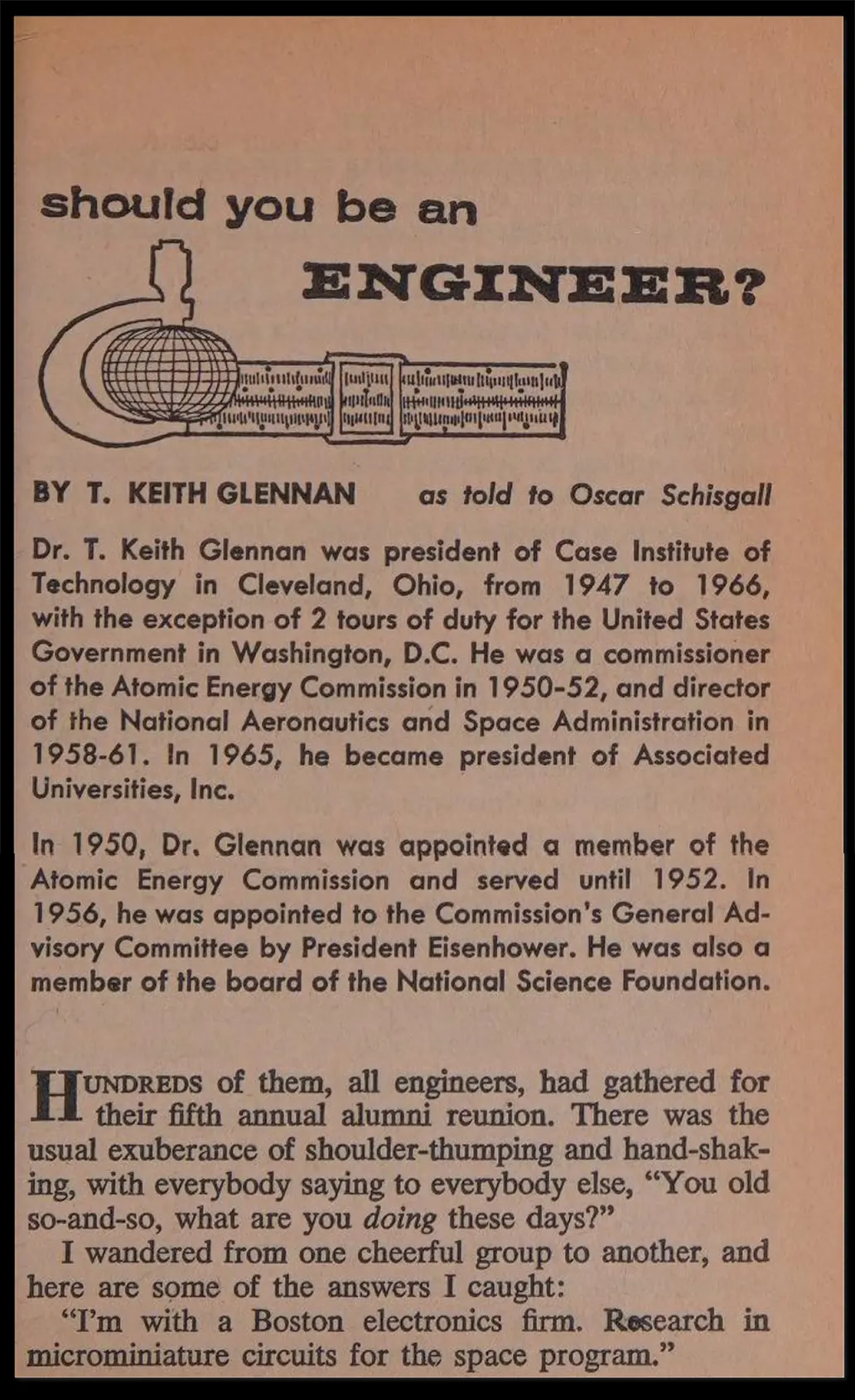
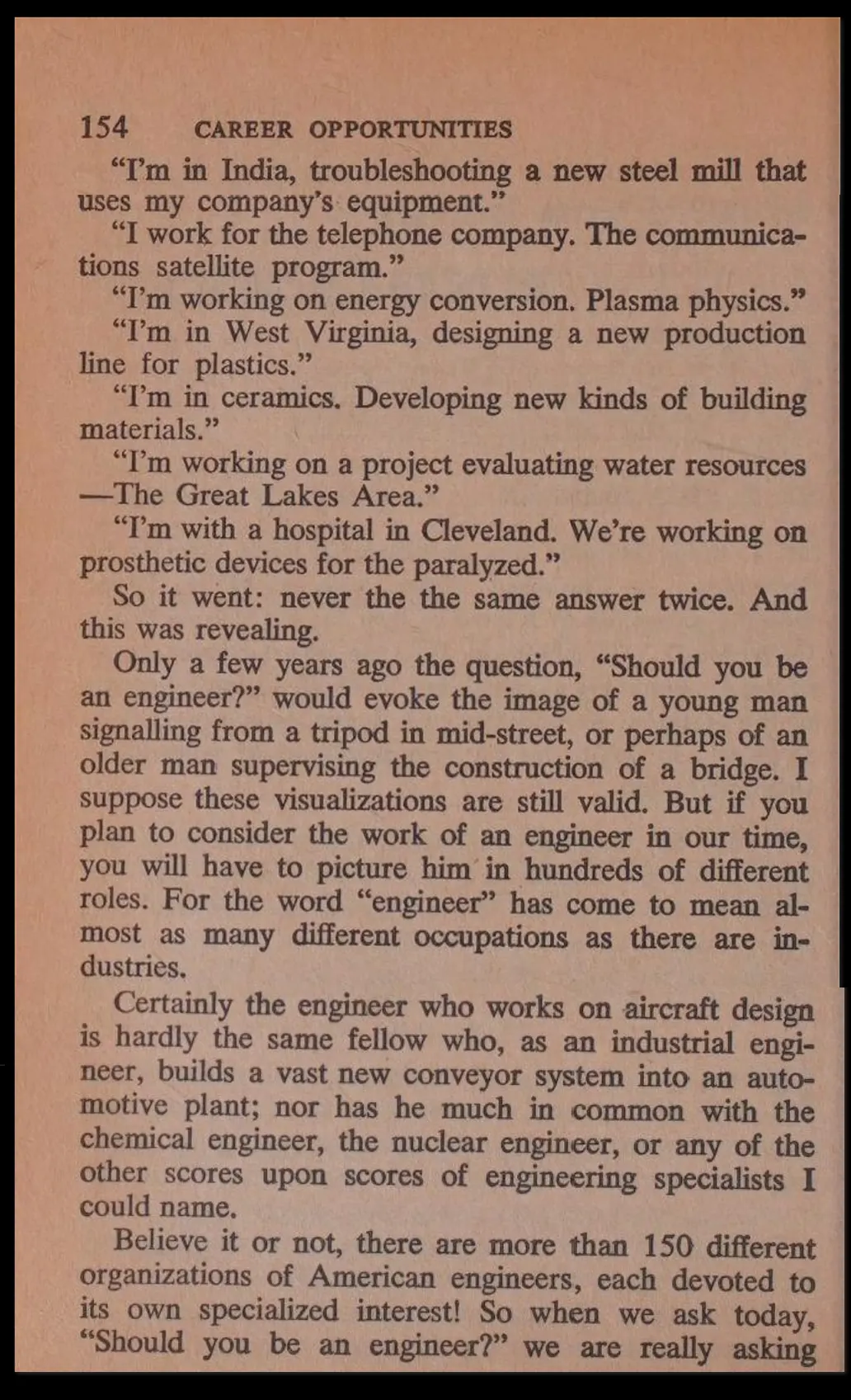
Should You Be an Engineer, T. Keith Glennan; New York Life Insurance Company; career information service; 8th revision; September 1966. An excerpt from the 8th revision (1966) of a New York Life Insurance Company career information service pamphlet

I liked making things. I carried around this Popular Science Audible Tach project for weeks while I worked on it in my Electronics class in high school. We also built power supplies and amplifiers from vacuum tubes. I still have the schematics. My electronics teacher at Oakland High, Mr. Ferguson, piqued my interest in engineering by explaining that an engineer might create a device to measure the temperature differential on a leaf.
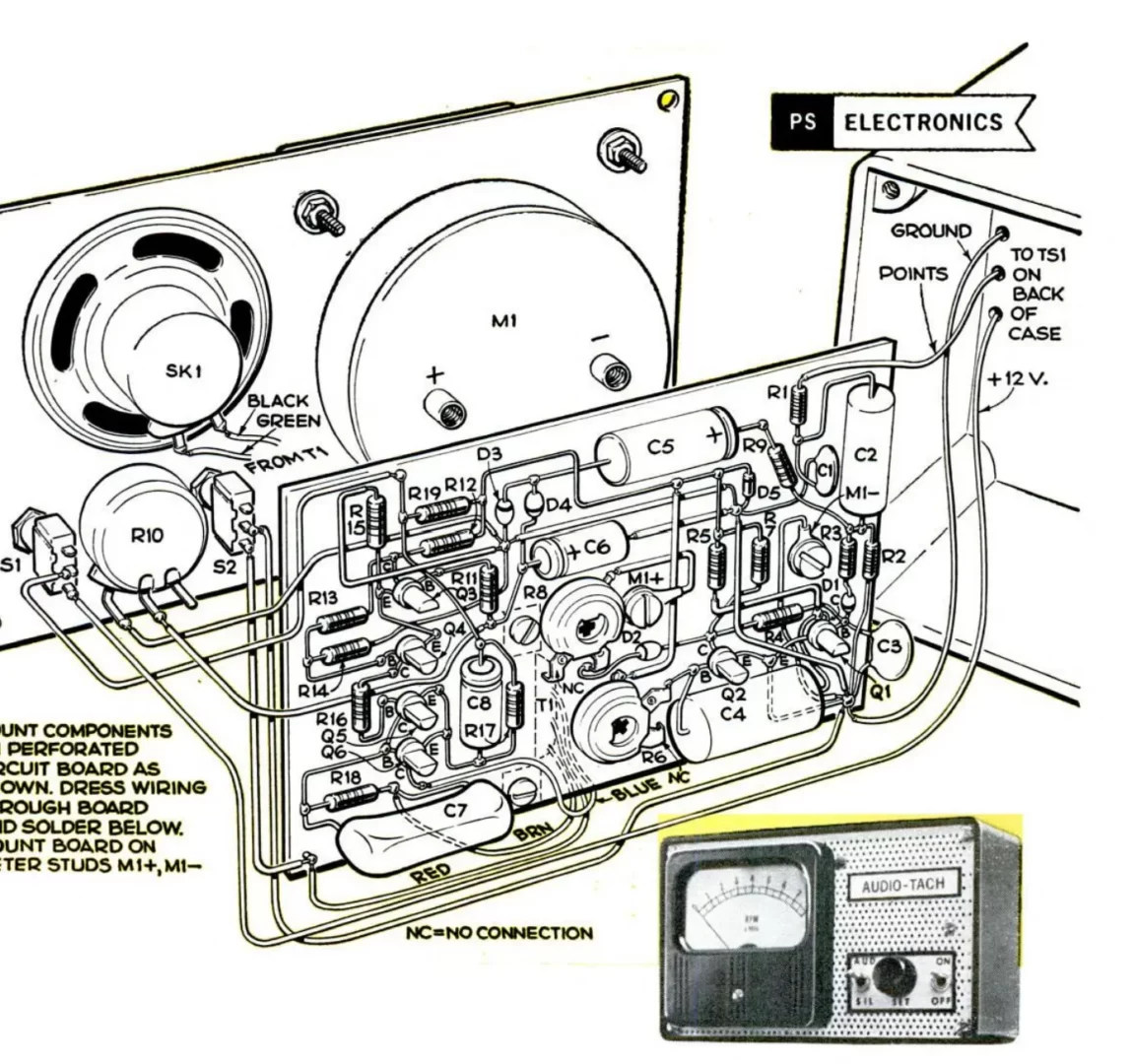
Audible Tach for your car or boat; Popular Science; December 1968; page 121
From Popular Science, December 1968, page 121; Audible Tach for your car or boat;

I was an A or B student in math, physics and chemistry so accordingly, I applied to the engineering programs at UC Berkeley, Caltech, MIT and Harvey Mudd. I was accepted only at Berkeley.

In the fall of 1970, I started at the College of Engineering at Berkeley. My first quarter, I took Math 1A, Engineer 1, Philosophy, Art History, and Asian Studies. My advisor told me it was too heavy a load, but he let me do it. It may have been my downfall. I didn’t realize it at the time, but I was trying to learn a new mathematical language (Calculus) and a new machine language (Fortran) while simultaneously writing papers for three different departments.
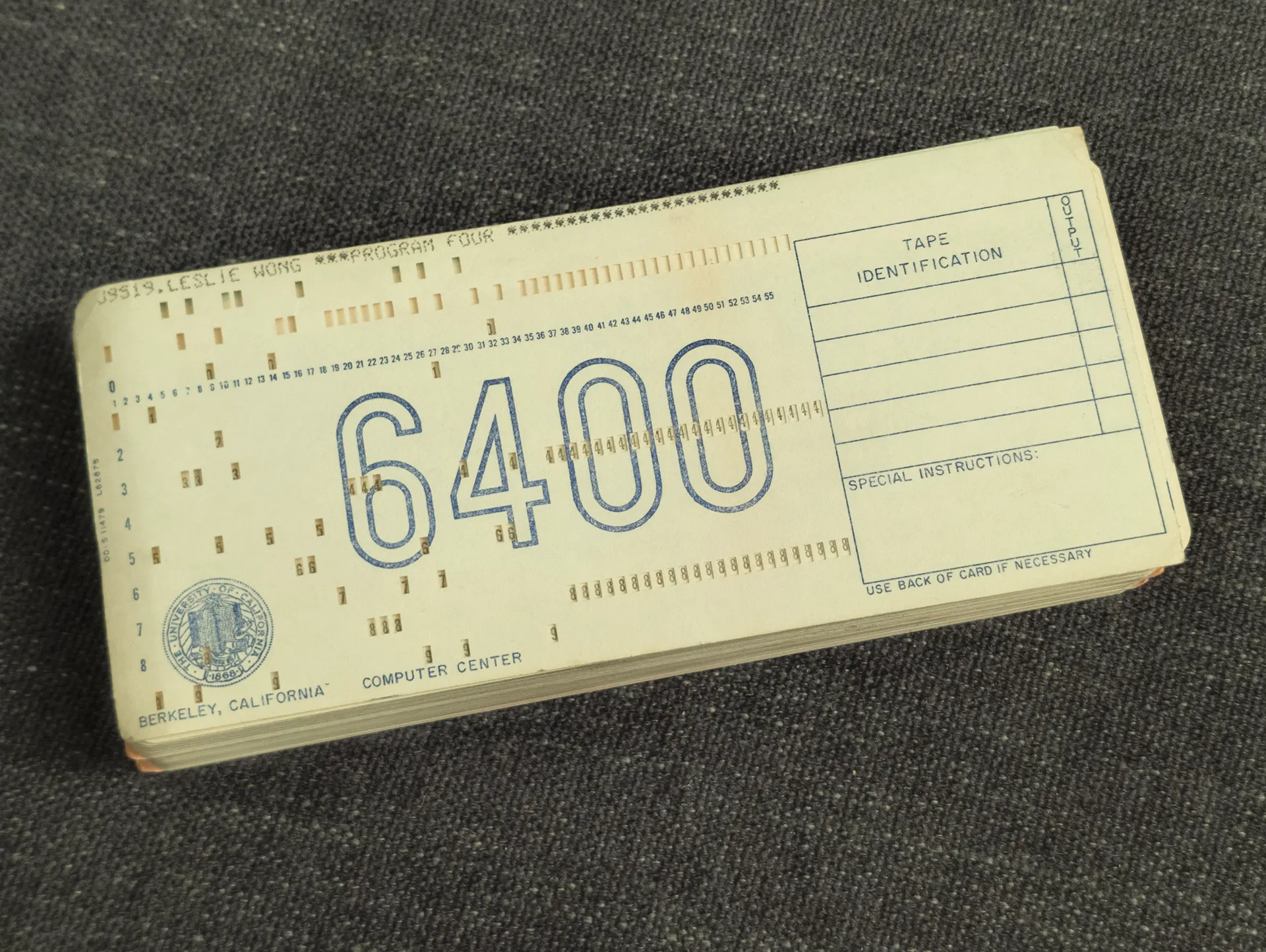
A hand-punched FORTRAN IV job deck for the Engineering E1 course, Fall 1970, UC Berkeley

Engineering 1 was something like Computers and their Applications. We learned Fortran IV, used an IBM 029 Keypunch to write the code to punch cards, then submitted the deck to Computer Center. The next day, you’d pickup your green-and-white striped printout.

I learned how to jump the line at the Computer Center using a remote terminal that produced your program on paper tape. Gemini says was likely a Teletype Model 33 ASR.

My engineering education at Berkeley didn’t last too much longer.
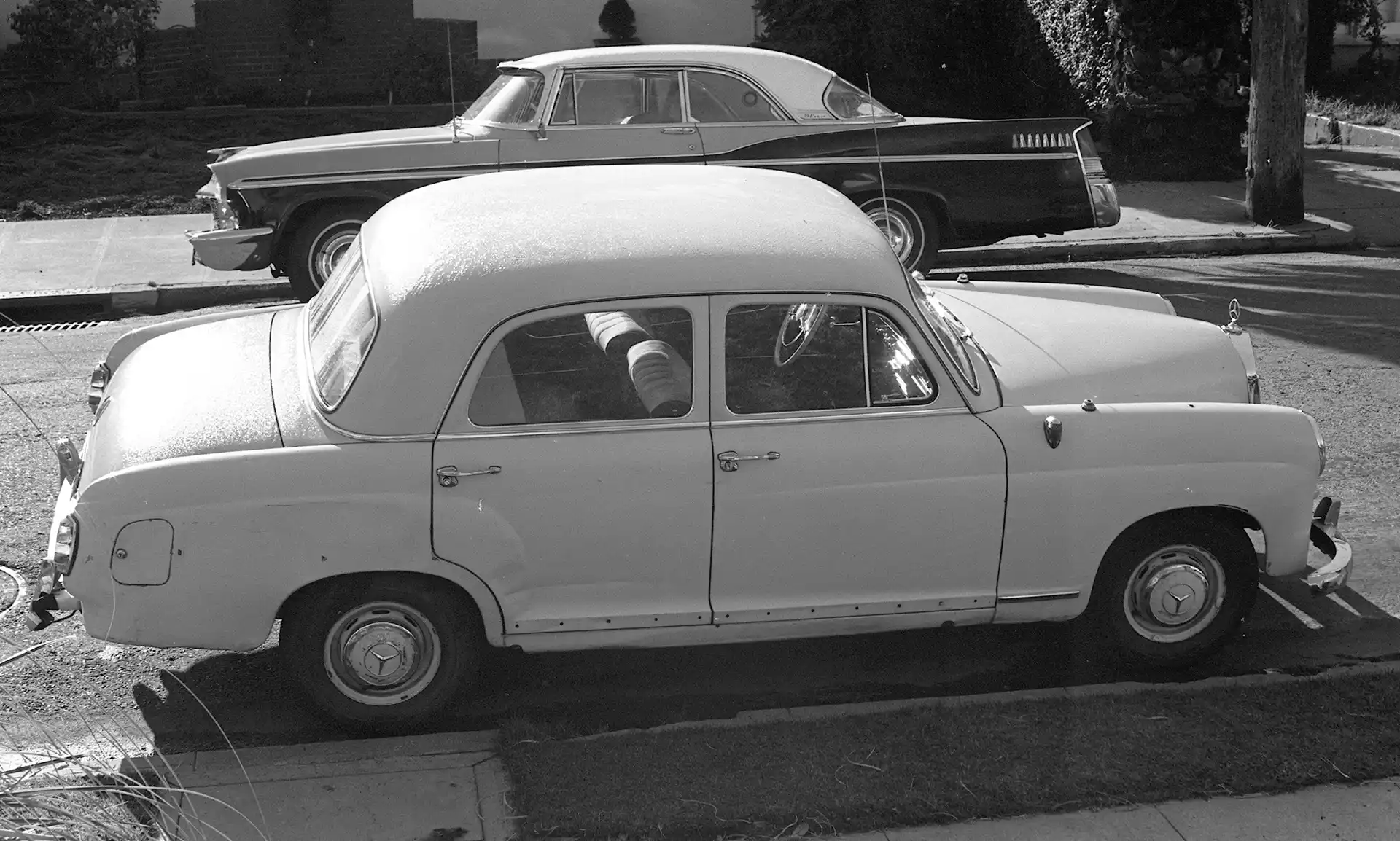
My First Car – A 1959 Mercedes Benz 190

About 20 years ago, at a family reunion, I told some of my cousins that, when I was a teenager, our Uncle John had given me 1959 Mercedes Benz 190. I was in Oakland High School and didn’t even have my driver’s license. They gasped.

1959 Mercedes Benz 190 (W121)
My 1959 Mercedes Benz 190 on Calmar Ave – it had a four on the column shifting

That sounds like an extravagant gift from a rich uncle. The reality was that it was from a generous uncle – one Christmas, he literally gave me the shirt off his back when I told him that I liked his Hawaiian shirt. But the car wasn’t running and it was slightly beat-up. It had a few dents, it was missing some rocker panel trim, it was missing a section of the rear bumper and mainly, the car wasn’t drivable. Uncle John thought that there was something wrong with the transmission.

I went to European Motors, then the Mercedes Benz dealership in Oakland, to buy an interior lightbulb. On the counter of the parts department, I saw the first edition of a hardcover book, Glenn’s Mercedes-Benz Repair & Tune-Up Guide. When I flipped through it, I saw photos of a transmission being rebuilt and thought, “I can do that.” That was my introduction to my version wrenching in California in the 1960’s.

Beyond the book, my main source of help was my next door neighbor, Mr Algie. Somehow, we determined that there wasn’t a problem with the transmission. The drive shaft flex joint had failed and the drive shaft was hitting the drive shaft tunnel. He also thought that the low oil pressure and the engine knock was due to worn bearings and rings. The engine needed rebuilding. My solution up to that point was to pour in a can of STP.

I was amazed when Mr Algie showed me how to use Plastigauge, to measure bearing clearances. I learned what scored bearings looked like. And I realized why STP quieted the bearing knock. He also loaned me a lot of the tools that I needed to do the engine rebuild.

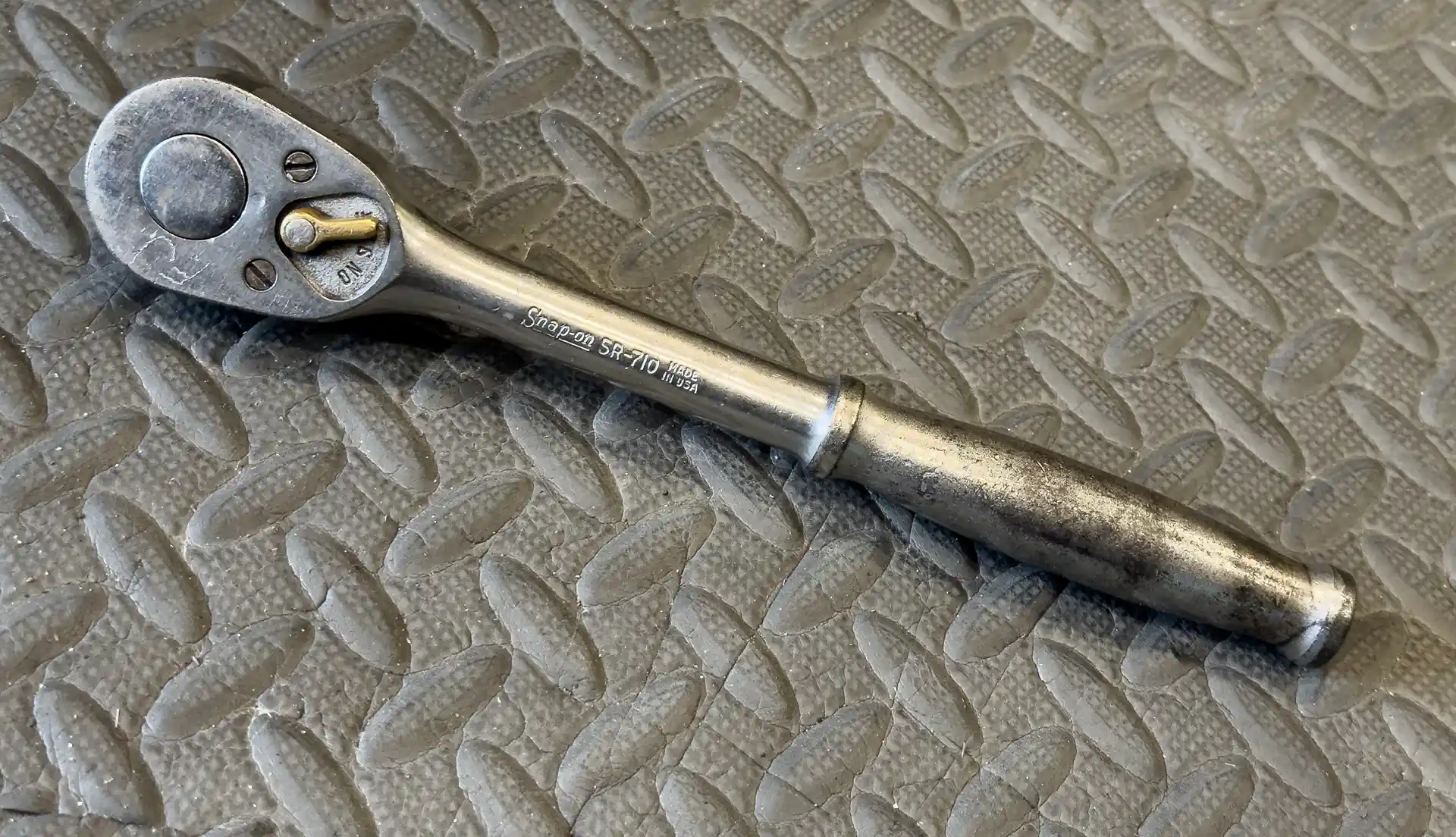
Snap-on SR-710, 1/2
The Snap-on SR-710, 1/2″ Drive Standard Handle Ratchet that I permanently borrowed from Mr Algie 57 years ago. Maybe it was Fritz’s, since it had FJ (Fritz Jarmin) etched into the head.


Eugene also helped me. My parents bought us matching (white!) Ben Davis coveralls (affiliate link) that we wore when we worked on the car.

From what I can remember from working on the car 57 years ago, an interesting design of the 1959 Mercedes Benz 190 was that the engine was mounted on a subframe. After disconnecting the engine plumbing, electrics and mechanicals, there were three big bolts holding the subframe to the rest of the car. After removing those bolts, you could raise the car up and roll out the subframe on the front tires, and then the engine was out – on sort of a rolling work stand.

The problem was how to get the car high enough to roll out the subframe. Uncle John had made two ramps by crisscrossing 2x4s. They were a little less than a 18 inches high. Somehow, Eugene and I used ropes and two bumper jacks on the wooden stands to raise the car high enough to get the subframe out. I can not imagine why I was doing this, but after the subframe was rolled out, I was standing inside the engine compartment and the car fell off the jacks. Miraculously, I was untouched. There could not have been a more dangerous operation.

I was lucky that I was able to have the car to drive to Oakland High School. After the hood ornament was stolen, I made an alarm that activated the car’s horn when someone moved the hood ornament. Of course there were times after school when I’d come back to my car and the horn was honking.

I even drove it to go skiing in the Sierras – probably to Sugar Bowl – a 6,883 ft (2,098 m) climb. I wasn’t particularly mindful of how powerful the engine was, but I remember on one trip, it was so slow going up a hill we stopped so I could try something. I thought that by rotating the distributor to change the ignition timing we’d get more power.

(Some specs of the 1959 Mercedes Benz 190 (W121) have it at a curb weight of 1200 kg / 2646 lb and 84 HP)

When it was time to move on to another car, I said good-bye to the 190. I wanted something that was silver and had a 5 speed transmission. In 1970, there weren’t many affordable cars that fit that latter description. I got lucky and found a used 1967 Alfa Romeo Giulia Sprint GT Veloce (‘step nose’ ). It’s another one of the cars that I wish I had today.

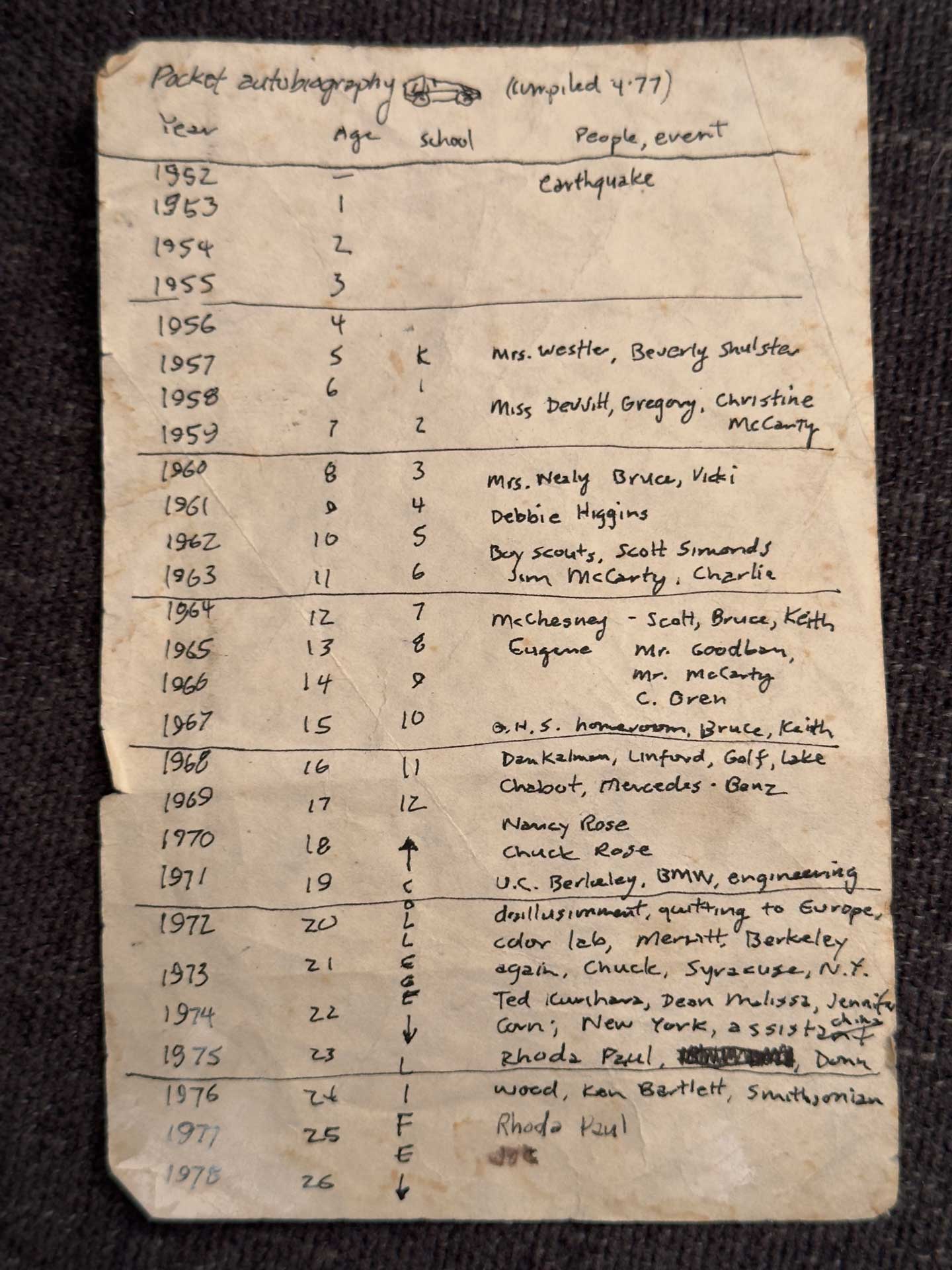
Pocket Autobiography – April 1977

In New York City, almost 48 years ago, I used a 4×6 inch piece of paper to write down the names of significant people, places and events in my then almost 25 year old life – from 1952 to 1977

Pocket autobiography of Leslie Wong written on a 4x6 inch piece of paper in April 1977 mrlesliewong
Pocket autobiography of Leslie Wong written in April 1977