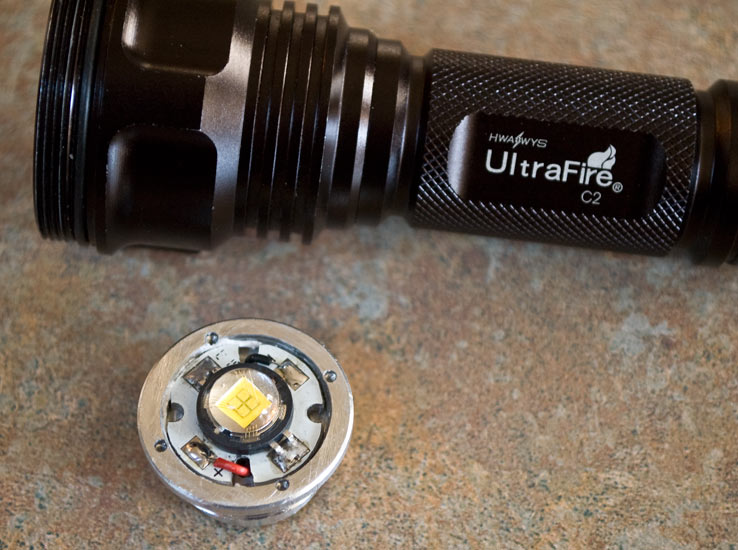
In the Home Made and Modified Lights section, jirik_cz modded his Ultrafire C2 flashlight with a SSC P7. For power, he used a Li-Ion 18650 3.7V battery directly driving the LED. It is a simple and elegant mod.
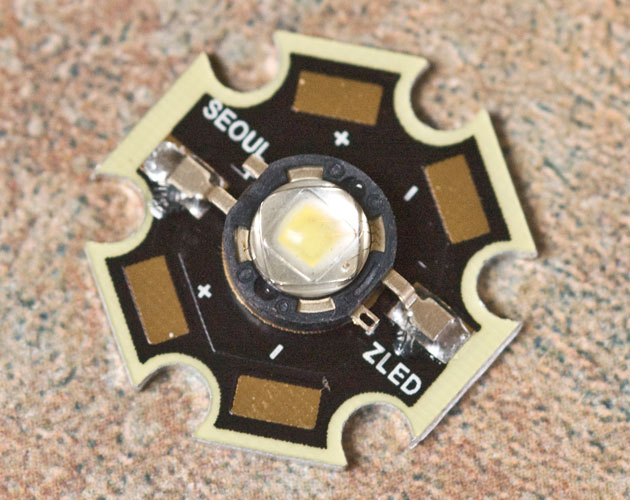
I happened to have a spare Ultrafire C2 flashlight waiting for a great idea like jirik_cz’s mod. I already had the P7 emitter (C bin) mounted on a heat sink base. An advantage of having the P7 emitter on a heat sink base is that the positive base of the bare emitter is isolated from ground.
I used a Dremel to enlarge the Ultrafire pill so the P7, on some heat sink compound, fit perfectly.
For the positive battery contact side of the pill, I stripped a 17mm diameter circuit board and soldered the LED leads to it. To accommodate the larger diameter LED, (the Ultrafire C2 uses a Cree XLamp® XR-E LED), I enlarged the hole in the reflector with a reamer.
Thanks to jirik_cz, now I have a 5″ (130mm) long flashlight that is a bright as my Roar of the Penguin.
Surefire describes the 6P as a “Compact (pocket sized), high-intensity incandescent flashlight for tactical, self-defense, and general use. (It) produces a smooth, brilliant, pre-focused tactical-level beam with three times the light of a big two-D-cell flashlight.”
The 6P’s stock lamp assembly is a P60 incandescent lamp. You can stop right there and you have a great flashlight that puts out 65 lumens.
Malkoff Devices M60 Drop-in
The Malkoff Devices M60 drop-in (now replaced by the M61 with a Cree XP-G) uses a Cree XLamp XR-E LED (Q5 bin) as a replacement for the incandescent lamp. In addition to being more rugged, it puts out 235+ lumens. Gene Malkoff, the creator of the M60 says, “It will easily illuminate objects at 350+ feet and will blind opponents within a 100 foot radius.” That’s what we want.
Naturally, when I get something new, I take it apart and think about how to mod it. My new Surefire’s switch seemed like a good candidate.
The Surefire Z41 tailcap is standard on the 6P. It has a momentary option by pushing the tailcap switch. Rotating the tailcap will turn on the light for constant operation.
Surefire Z41 tailcap with McClicky switch
Most of my flashlights use a forward clicky switch. A slight press of the switch (before it clicks), will momentarily turn on the light and a full press (when the switch clicks), will latch it on. I’ve put the McClicky switch in seven or eight of my flashlights and thought it would work well in the Surefire 6P. I could have bought a Surefire Z59 Click-on Tailcap Switch or the Oveready McClicky Kit for USD $22, but it’s more satisfying making my own.
I yanked out the insides of the existing switch and unscrewed the retaining ring. Sometimes the retaining ring is glued. I’ve put the tailcap in a ziplock bag and boiled it hot water for five minutes and the glue will release.
McClicky Switch with soldered brass tab for contact
Since I only had a plastic retaining ring to hold in the new switch, I soldered a piece of brass to the McClicky switch so that it contacts the inside of the switch housing. I put a dab of solder on the contact on the other side so the retaining ring would seat the switch flat inside the tailcap.
If you have an aluminum or brass retaining ring, there is no need to solder a tab – just screw it in. You must be careful about the inner part of the retaining ring contacting the positive connection on the raised plastic below the contact spring – it will short out the switch and be “on” all the time. A piece of shrink tubing or electrical tape wrapped around it will prevent a short.
Using that piece of brass also meant I had to remove the anodizing from the inside of the housing so the brass tab makes electrical contact with the side of the tailcap. With one mod that I did, I lost the lock out function, which “prevents accidental activation of light during tactical engagements, transportation, or storage,” according to Surefire. On another mod, the lock out still worked. In my case, I’m very unlikely to have a tactical engagement, so I can remove the batteries for transportation and storage.
Glow-in-the-Dark Silicone Tailcap
To bottom it off, I replaced the black rubber push button cover with a Glow-in-the-Dark Silicone Tailcap…maybe a not too tactical feature.
When I found a LED circuit board that had an input voltage of 4v-18V, I thought it would work well as a driver for an automotive LED bulb. The circuit board uses a Micro Bridge Technology PT4105 (PDF specs) step down LED driver.
I took an 1156 bulb to use as a base for the circuit board and LED. I broke out the glass and filament and used JB Weld to glue the components together.
BMW Bavaria Tail Light
The LED was brighter than the 1156 bulb, but it had a noticeable hot spot, even though the Cree LED has a 90 degree viewing angle. Heat doesn’t seem to be a problem; the Bavaria’s light socket dissipates the heat well.
Joe Weir, on the Senior Six Mailing List, suggested using a diffuser lens. I’ll have to find something then report back.
In an endless quest for brighter LEDs for my flashlight modding, I received some LEDs today that I ordered from DealExtreme.com. DealExtreme is a Hong Kong based vendor that sells DIY flashlight parts, among a lot of other (some interesting, some not) – junk.
Seoul Semiconductors says, “(the) Z-Power LED P7 series is single LED package providing the world highest brightness of 900 lumens and the efficacy of 90 lumens per watt to replace the conventional bulbs.”
adrrain67 over at digg.com writes, “LEDs are fantastic. But for a long time, they’ve been fantastic more because of what we think they can do than what they actually do. We’ve been pretty sure that LEDs can produce warm, white light at efficiencies far beyond even the much-touted compact fluorescent bulbs. But we’ve yet to actually see that.”
I bought this RLM type industrial reflector to put in our carport, with the intention of lighting it with LEDs. The first iteration involve a string of white LED Christmas lights mounted through holes drilled in a board. Then I thought about a 110 VAC LED lamp, but most are down firing and wouldn’t use the reflector. Now I am looking at an LED driver puck like this, and a Cree LED mounted on a heatsink.
To provide the best experiences, we use technologies like cookies to store and/or access device information. Consenting to these technologies will allow us to process data such as browsing behavior or unique IDs on this site. Not consenting or withdrawing consent, may adversely affect certain features and functions.
Functional
Always active
The technical storage or access is strictly necessary for the legitimate purpose of enabling the use of a specific service explicitly requested by the subscriber or user, or for the sole purpose of carrying out the transmission of a communication over an electronic communications network.
Preferences
The technical storage or access is necessary for the legitimate purpose of storing preferences that are not requested by the subscriber or user.
Statistics
The technical storage or access that is used exclusively for statistical purposes.The technical storage or access that is used exclusively for anonymous statistical purposes. Without a subpoena, voluntary compliance on the part of your Internet Service Provider, or additional records from a third party, information stored or retrieved for this purpose alone cannot usually be used to identify you.
Marketing
The technical storage or access is required to create user profiles to send advertising, or to track the user on a website or across several websites for similar marketing purposes.