Monkey Memories
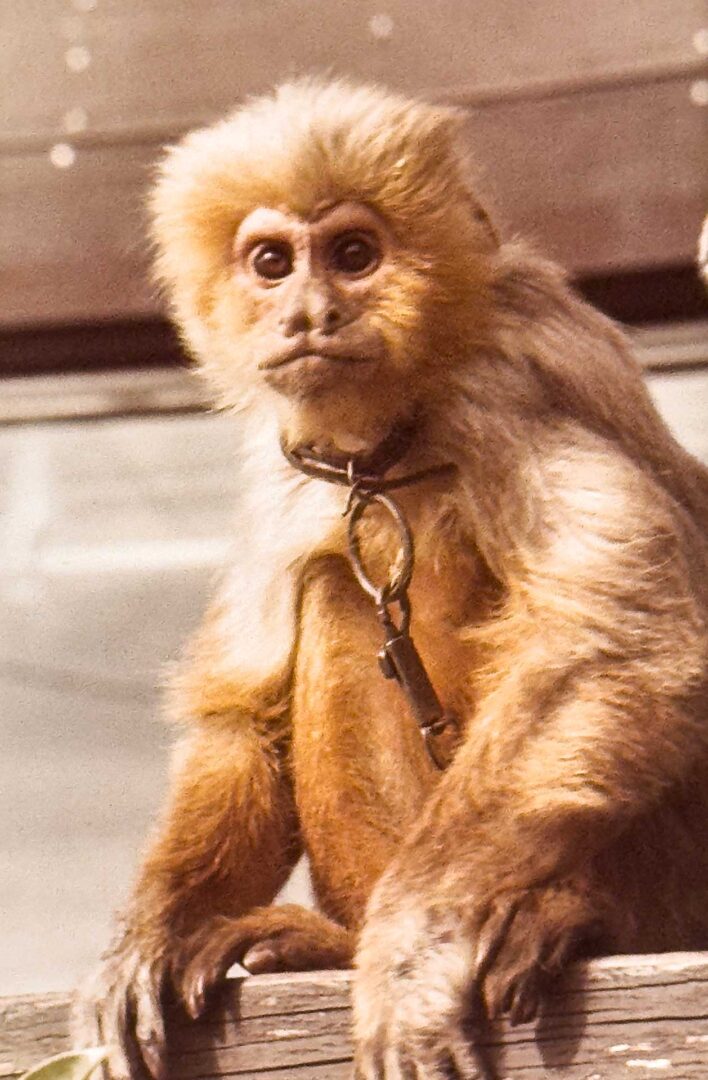
One morning, before my day in 5th or 6th grade at Crocker Highlands School, I was in the kitchen getting something to eat. I heard a noise in the downstairs water closet. The small room had only a toilet and a single window eight feet above the floor that opened to the garage roof. When I opened the door, I saw a light tan colored tail, curled and sticking out from behind the toilet. It was attached to a monkey.
My parents were still in their bedroom when I went to tell them. They called the”Oakland pound” (Oakland Animal Services). The “pound” came out and picked up the monkey to quarantine it, and three weeks later, they said, it’s yours. Somehow, my parents agreed to have a fifth member join the family, and we named him Charley.
I have a faint recollection of seeing a monkey on our clothesline a few days before. Our backyard had a lot of fruit trees: pear, loquat, orange, apple and lemon trees. There were also blackberries, wild strawberries. Maybe that’s why Charley was hanging around our house. But we never found where Charley came from. When we found him, he was very young, had a gash on his leg and no collar.
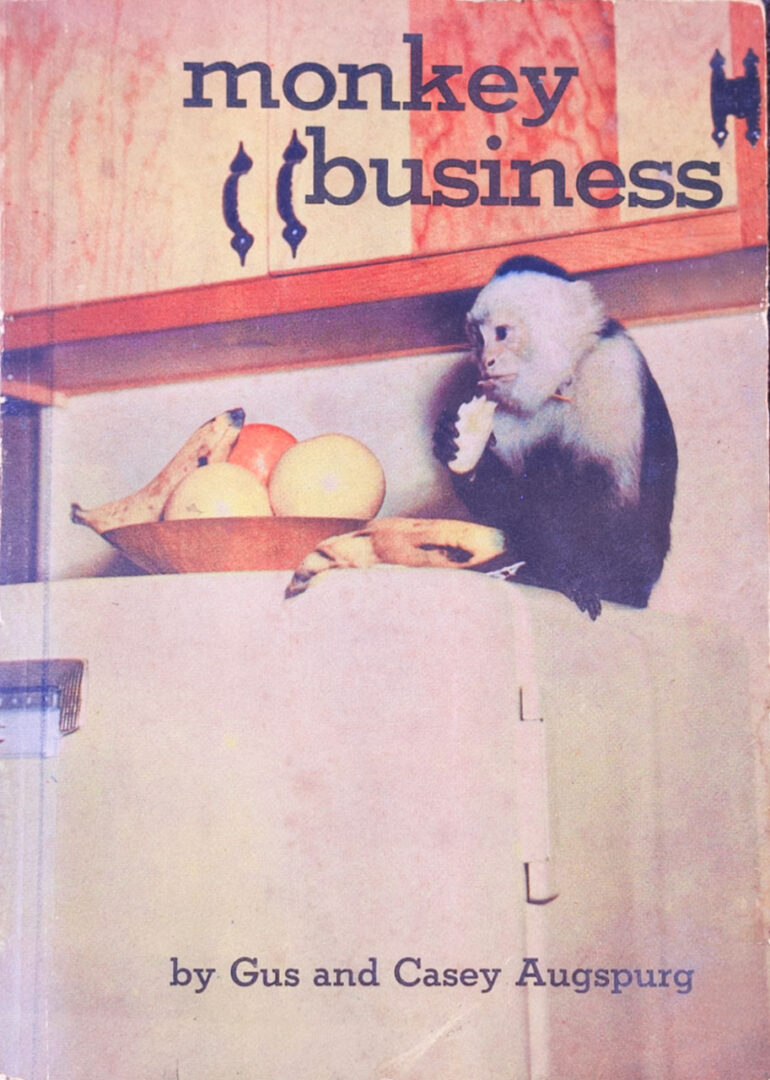
In the early 60s, monkeys were sold in pet stores. We went to a pet shop on Fruitvale Avenue in the Dimond District of Oakland and bought a cage and a book – “Monkey Business,” by Gus and Casey Augspurg.
The cage that we put in the basement was about 4’x3’x3’ . At first, during the day, we kept Charley outside in the front yard with his leash attached to a spiral tie out stake. He could jump up and climb on the magnolia tree. At night, Charley would sleep in his cage in the basement and in the morning, he would let us know that he was awake by shaking his cage.
Charlie’s canine teeth were sharp. Once, when he bit the middle finger on my right hand, I instinctively pulled my hand away and caused a laceration. I still have scars on my hand from Charlie’s bites.
When he bit a kid, Charlie moved into a big cage. My Mom got a cage from one of her bridge player friends who had something to do with Children’s Fairyland. It was a big cage on casters, maybe 6’x5’x4’ with a bar at the top for a perch, and a rope hanging down the middle for swinging.
Our morning routine was the give Charley some milk to drink, about two or three ounces, warmed up in an old pill bottle. My dad (an accountant) used to get produce from one of the supermarkets that was one of his clients. Charlie ate lettuce, carrots, nuts, fruit, insects and an occasional raw egg. Besides those things, we started feeding him food that we ate. We’d put some cooked rice in a cupcake baking cup with whatever protein our dinner had: a shrimp, a little piece of beef.
Most of the time, my dad took Charley inside to his basement cage at night. They’d sit on the front porch for a while as my dad smoked a cigar before going down to the basement.
Once Charley got out of his cage and ran down the street. He climbed a tree in front of the Duhe’s. I ran down the street after him and when I called him, he came right down to me.
So we could take Charlie on vacation with us, Dad bought a 1964 Ford Fairlane 500 Ranch Wagon. It was Wimbledon white with a 289. (I later probably cracked the engine block on a trip to LA with Bruce Baxley, by pouring cold water into an overheating engine). I remember one trip to Monterey. My dad had a friend that owned the Casa Carmelkorn store on Fisherman’s Wharf. Our family would drive down from Oakland and stay at the Borg’s Motel. Charley slept in a cage in the car.
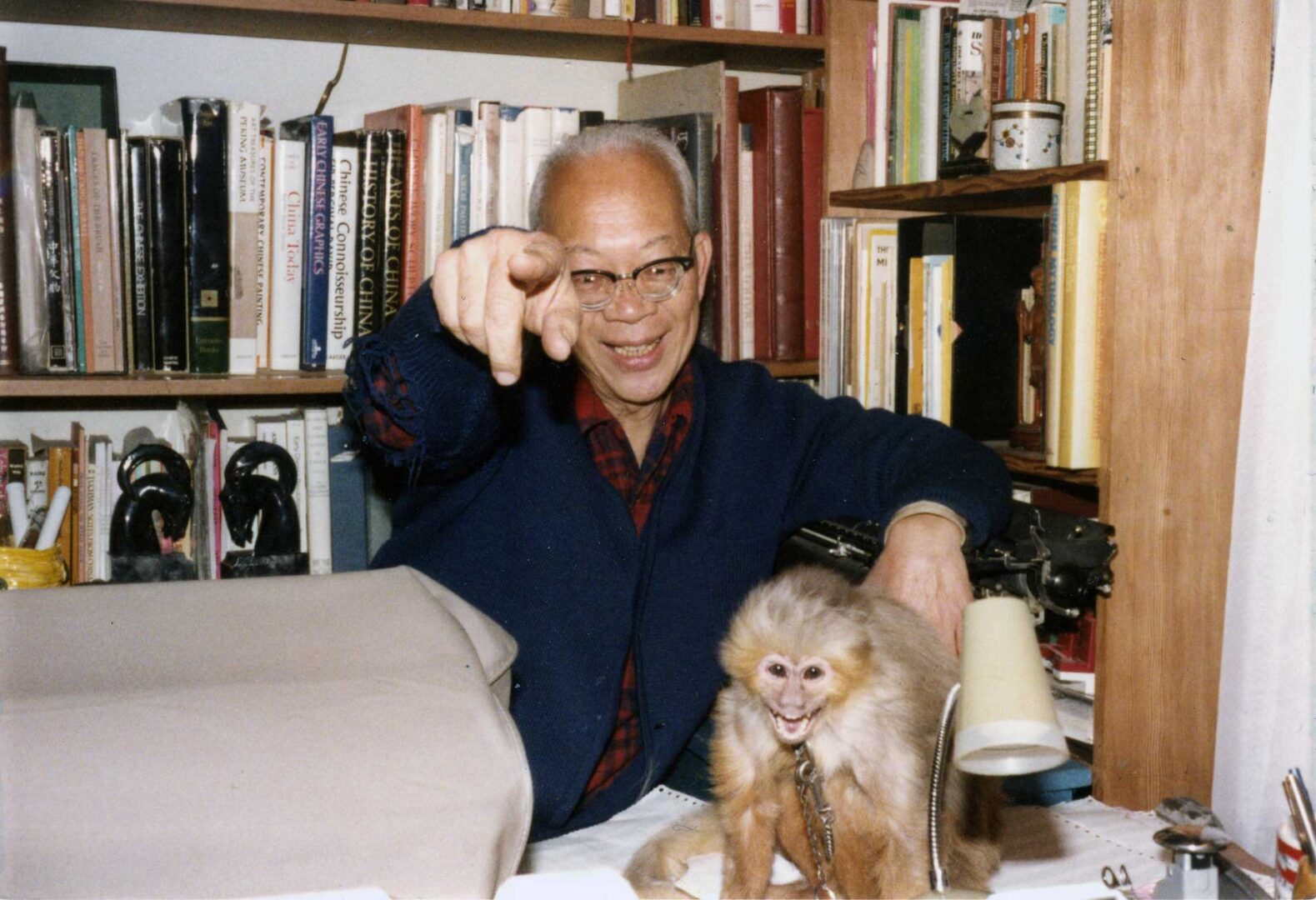
Charley liked to draw. On the way to the basement, Dad and Charley would go through my Dad’s office. Dad had those large continuous form computer printouts and Charley would take a pen or pencil (after chewing on it a little) and scribble on the printouts. It seemed that Charley was aware that he was having an effect with his drawing.
We only had one telephone for the entire house. It had a long extension cord that reached almost to the top of the stairs to the second floor. My mom used to sit on the stairs talking to her friends in Chinese. (That’s how my ear became attuned to the Shanghai dialect, even though I can’t understand it) My mom would be on the phone with Charley on a leash. Charley would draw on the wall with a pencil.
After my dad died in 1980, it was just mom taking care of Charley. My sister, Alberta was living in Houston or Boise, and I was living in New York.
One time I came home from New York, Charley had a large tumor on his chest. My mom took him to the vet, and the tumor was removed. The vet said that Charley wasn’t getting enough fat in his diet. The vet said to feed him Purina High Protein Monkey Chow. Charley didn’t like it.
By the early 90’s, Charley had been in the family for almost 30 years. He was getting a little too difficult for my mom. She found a primate sanctuary (though I can find no record of it) near Davis, California that took Charley.