
with apologies to Ed Ruscha.

The blog of a Leslie Wong
with apologies to Ed Ruscha.
The YouTube description from NASA Goddard: “Launched on Feb. 11, 2010, the Solar Dynamics Observatory, or SDO, is the most advanced spacecraft ever designed to study the sun. During its five-year mission, it will examine the sun’s atmosphere, magnetic field and also provide a better understanding of the role the sun plays in Earth’s atmospheric chemistry and climate. SDO provides images with resolution 8 times better than high-definition television and returns more than a terabyte of data each day.
On June 5 2012, SDO collected images of the rarest predictable solar event–the transit of Venus across the face of the sun. This event happens in pairs eight years apart that are separated from each other by 105 or 121 years. The last transit was in 2004 and the next will not happen until 2117.
The videos and images displayed here are constructed from several wavelengths of extreme ultraviolet light and a portion of the visible spectrum. The red colored sun is the 304 angstrom ultraviolet, the golden colored sun is 171 angstrom, the magenta sun is 1700 angstrom, and the orange sun is filtered visible light. 304 and 171 show the atmosphere of the sun, which does not appear in the visible part of the spectrum.“

I bought a used Surefire KX2 head for my Surefire E2D, so I had a spare Veleno Designs E-Series tower module in search of a flashlight. I found a Vital Gear FB1, which is a single cell, Surefire E-Series compatible body with a forward clicky switch.
I’ve been carrying this flashlight built with the Veleno Designs E-Series 3 mode, neutral white, tower module; a slightly de-pronged Surefire E-Series Defender head and the Vital Gear FB1 body. The Veleno Designs module is about 140 lumens on the brightest mode and it has a good low mode. The flashlight is very light, compact and is only about 3″ long (77mm). It’s a lot brighter than a Surefire E1L Outdoorsman and about 1″ (25.4mm) shorter.
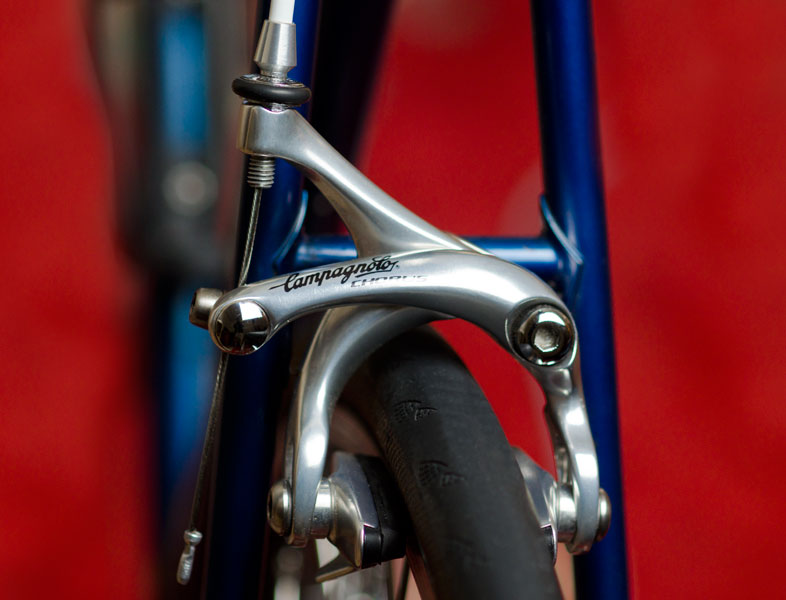
I upgraded my De Rosa’s brake calipers from a 43-year-old design (Campagnolo Super Record) to a 17-year-old design (Campagnolo Chorus). The “new” calipers (the eBay seller called them “vintage”) are dual-pivots with Campagnolo and Chorus imprinted on the brake arms. I used lined housings and stainless steel cables so in all, the stopping power feels like a significant upgrade over the Super Record calipers I was using. The new calipers seem to work OK with the mid-80’s C-Record levers although the quick releases on the levers to open up the calipers for wheel changes are a little inadequate because I’m using a 25mm wide rear tire.
Dr. Peter Jansen, founder, describes the Tricorder Project. His first Tricorder project prototype had atmospheric, electromagnetic and spatial sensors.