
Dragon, Kearny Street, 2013 Chinese New Year Parade San Francisco, California (Community Youth Center San Francisco)

The blog of a Leslie Wong
Dragon, Kearny Street, 2013 Chinese New Year Parade San Francisco, California (Community Youth Center San Francisco)
To get up into the hills, I ride my bike through glass strewn, broken city streets. Including the weight of my bike, I’m pushing almost 100 kg. I was getting a lot of punctures from very small pieces of glass, frequently enough that I started to consider tire savers. If I hear a crunching sound or ride over small pieces of glass I don’t see in time, I reflexively put my thumb down on the rotating tire to hopefully flick off debris.
Though I need a rear tire that is more resistant to punctures, I also didn’t want to compromise too much on weight because I am riding a racing bike, even though it is from the early 80’s. Years ago, when I lived in Manhattan, I went from tubular tires to a Specialized Armadillo. It was like putting on a truck tire.
After I read Bruce Weber’s account of his flatless cross country bicycle ride with Schwalbe Durano tires, I bought a Schwalbe Durano Plus. With a folding bead, the 700 x 25C tire weighs 380 gm. Compared to the Continental Grand Prix 4-Season (that I was riding in a less demanding environment) the Schwalbe Durano Plus tire had a certain sluggish response.
One of my local bike shops suggested a Continental GatorSkin. They didn’t have the foldable version so I bought the 300 gm, wire bead, 700 x 25C. The GatorSkin felt more responsive than the Durano Plus and through it’s life, I only had one puncture. Unfortunately, the cord started showing in one spot after about 3500 miles.
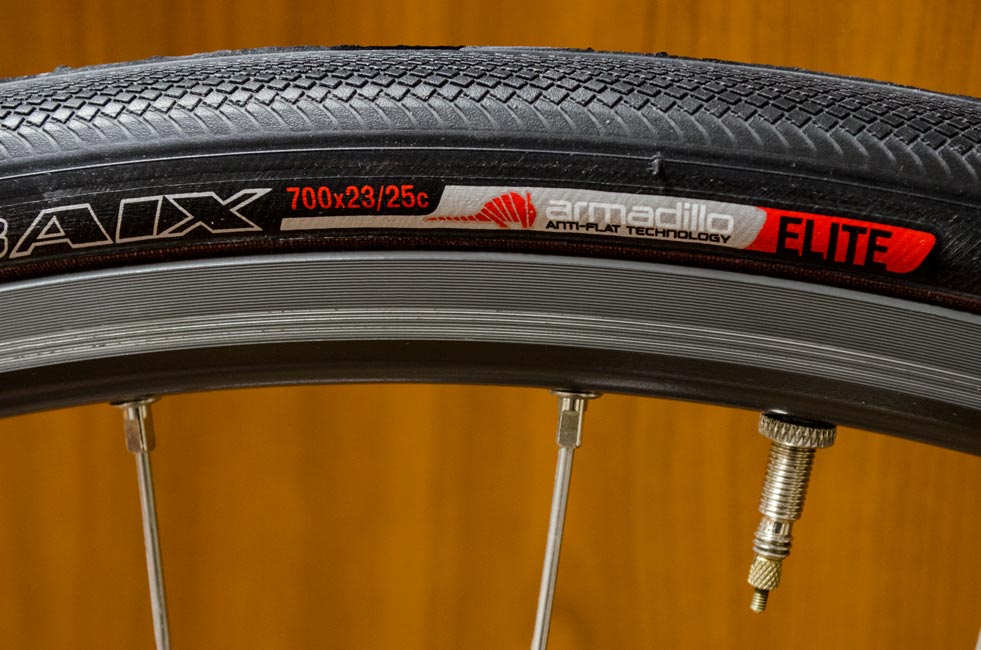
I would have bought a folding Gatorskin, but LBS #2 wasn’t a Continental dealer. They suggested a Specialized Roubaix Armadillo Elite. I mounted it on my Mavic Open Pro wheel without shredding my thumbs or using tire irons to get the final part of the bead over the rim. Even though it weighs 305 gm, the Elite feels more responsive than the other two tires. For $60, I hope it wears well.
Specialized says, “The Roubaix is an Endurance Road tire for epic rides from smooth country roads to rough field roads.” Since my riding is none of the above, hopefully it will just work.
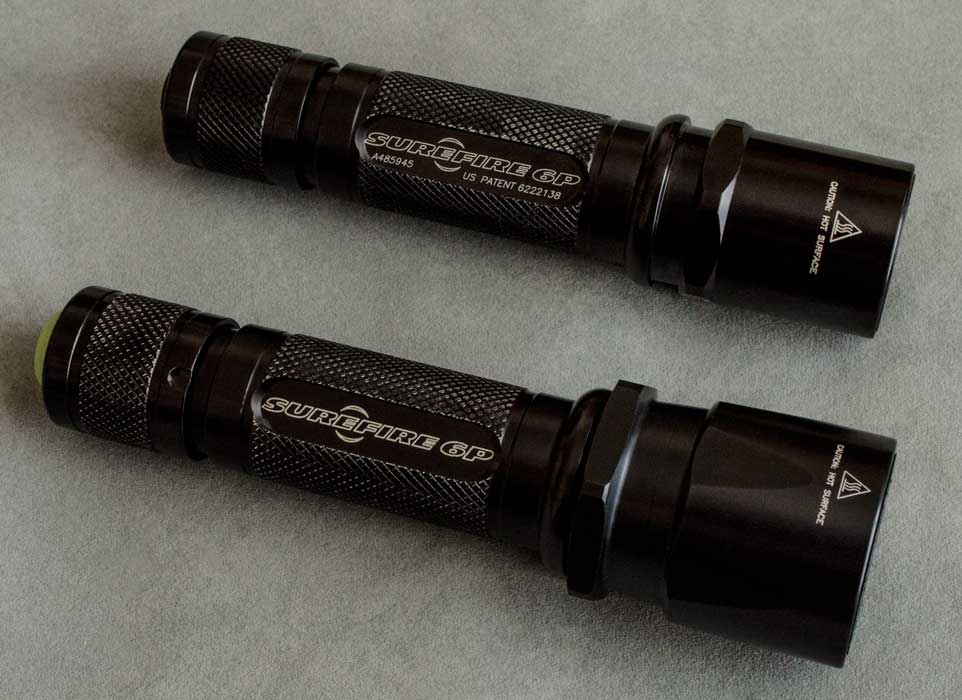
The Surefire Z32 bezel was used on the Surefire M2 flashlight and currently on the Surefire M951XM07 Millennium® Universal WeaponLight. The main design function of the bezel is to isolate the incandescent lamp assembly from weapon recoil shock. Since the shock mechanism reduces the heat dissipation ability of the bezel, I use aluminum shims or copper tape around the LED drop-ins to help dissipate the heat through the flashlight body.
The Surefire 6P, is to me, what a flashlight looks like (though I have moved on from incandescent lamp assemblies to LED drop-ins, such as this modified Malkoff M61). The stock Surefire 6P is 5.20″ (132 mm) long and the bezel diameter is 1.25″ (~32 mm). I like the current design of the Surefire Z32 bezel as opposed to the original design with the vented ribs. The Z32 bezel is about 1/4″ larger in diameter and about 3/8″ longer than the Z44 bezel that is standard on the 6P. With a Z32 bezel on a 6P body, it looks even more like a flashlight.

9th Street, Oakland, California, just hours before Super Bowl XLVII

When I went to Montano Velo to buy some spokes and a rim for a new wheel build, they sold me Phil Wood spokes. I bought double butted spokes, so it took a few minutes to prepare them on the spoke machine. I had always used DT spokes and I really didn’t notice that they weren’t DT spokes until I started threading them through the hub and saw “PHIL” embossed on the butted section near the spoke head. I used Damon Rinard’s free spoke length calculator, which is an Excel spreadsheet with macros, to calculate the length of spokes that I needed. After truing and dishing the wheel, the spoke length calculations proved correct.
I also used a Mavic Open Pro rim. The Mavic Open Pro rims have double eyelets, which hopefully distribute the stresses through the two sections of the rim. I considered the Mavic CXP33, which has more of a V-profile than the Open Pro. I guess I’m a traditionalist. I’m not interested in saving weight – I just need strong wheels that will hold up to someone who weighs 13.8571 stone and occasionally bunny hops on craggy Oakland streets. I have never had any problems with Mavic rims. In the past, I have used the G40, GP3, GP4, MA40 and MA3. On my first ride today, the wheel didn’t pretzel so I guess it’s working.
Camera: Nikon D7000. Lens: Nikon Micro-NIKKOR 105mm f/2.8