Windows Server 2012 on a Macbook

Windows Server 2012 Server Manager

After the failure of an old computer running Windows Server 2003, I setup Windows Server 2012 on a Macbook.

Years ago, I set up a Sony Vaio PCG-Z505HS running Windows Server 2003 at home so I could keep up with Macs and Active Directory. When I recently experienced problems with DHCP and DNS, I discovered that the Vaio had died. There was no LED power indication. My troubleshooting consisted of jiggling the power connector and checking the power supply voltage. When I measured voltage from the AC adaptor, I gave up, using the rationale that it had lived its useful life. The Vaio, with a Pentium 3, 500 MHz CPU, was introduced in January 2000.

Coincidentally, I had a hardware failure in my Macbook (late 2006), so I decided to repurpose it as a domain server using an evaluation version of Windows Server 2012.

The Windows Server 2012 installation was simple using the Server with a GUI mode installation. The Server Manager and configuration tools greatly simplify the setup. With Windows Server 2012 on a Macbook running silicon introduced in 2006 – an Intel® Core™2 Duo Processor T7200 that has Intel® Virtualization Technology (VT-x), the next step is to try virtualization. As a Macbook running OS X, I successfully ran VMware Fusion VMs running Ubuntu and Windows 2000, though I forsee the 3 GB of RAM in the current system will be a limiting factor.

The best part about running an Active Directory domain at home is joining computeres to the domain. The welcome message says, “Welcome to the lower_slobbovia domain.

Macbook in a Mini-ITX Case

Macbook (late 2006), disassembled

My Macbook (Late 2006) has gone through many modifications and operating systems. Recently, it decided to stop responding to keyboard or trackpad input. Instead of trying to replace the trackpad/keyboard cable (which I’ve done once already), I decided to put logic board of the Macbook in a Mini-ITX case and try an evaluation version of Windows Server 2012.

ifixit’s MacBook Core 2 Duo Logic Board Replacement guide was helpful with the disassembly. After removing the logic board, I stripped the bottom case of the remaining parts (SSD, hard disk, speakers, display, etc). The MacBook logic board was short enough to fit in the case with the ports and connectors lining up with the opening for the Mini-ITX backplane.

I thought using the Macbook bottom case would be the best way to mount the system board because the case helps to align the MagSafe connector and the fan/heatsink assembly. I also wouldn’t have to mount other stand-offs in the Mini-ITX case. I used Dremel cut-off wheels to cut down the case bottom. To mount the logic board in the Mini-ITX case, I used double-sided foam tape.

The wiring for the ancillary devices – Wi-Fi, Bluetooth and speakers – were routed around the inside of the new case. The Mini-ITX case came with a bracket to mount 3.5″ hard drives internally but with non-standard headers on the logic board, I abandoned that idea. There was also a power supply, which I removed. I wired the power switch on the front of the case to the trackpad/keyboard connector on the logic board.

Macbook in a Mini-ITX Case

I had already removed the DVD drive when it stopped working in the summer of 2011 and replaced it with an SSD. I used double-sided tape to mount the SSD and the second hard drive to a bracket mounted above the logic board. Eventually, the short cable for the second hard disk failed and when I replaced it, the connector on the logic board failed from too many insertions.

When I first powered it on, it actually worked. The Mini-ITX case is slightly larger than a Mac mini (200 x 225 x 56mm vs 197 x 197 x 36mm) and slightly less attractive but it works. My only regret was breaking the circuit board for the system LED when I was disassembling the case.

The Lady Washington

The Lady Washington, Jack London Square

The Lady Washington, a modern replica of the original USS Lady Washington, was sailing in San Francisco Bay this past week and docked at Jack London Square in Oakland this weekend. In the 2003 film, Pirates of the Caribbean: The Curse of the Black Pearl, the Lady Washington portrayed the fictional HMS Interceptor (and in Star Trek: Generations, she portrayed the brig, USS Enterprise – “Computer, remove the plank!“).

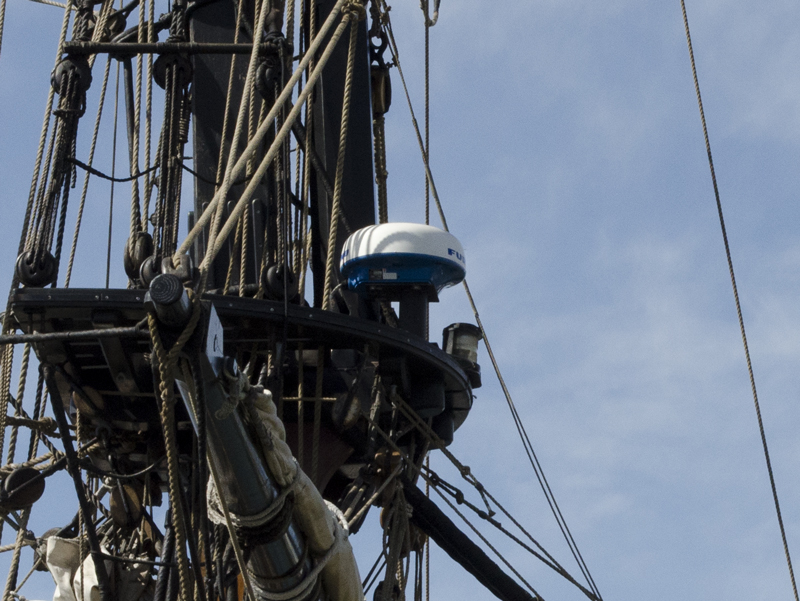
Furuno radome

According to the Pirates of the Caribbean Wiki, “The HMS Interceptor was a brig in the British Royal Navy serving under King George II, most notably under the command of Captain, later Commodore, James Norrington. As a ship in the British fleet, the Interceptor was purported to be the fastest vessel commissioned to His Majesty’s service.”

The Furuno radome, mounted on the foremast above the yard, probably helped capture some of those pirate ships, though in the end, HMS Interceptor couldn’t escape the Black Pearl.

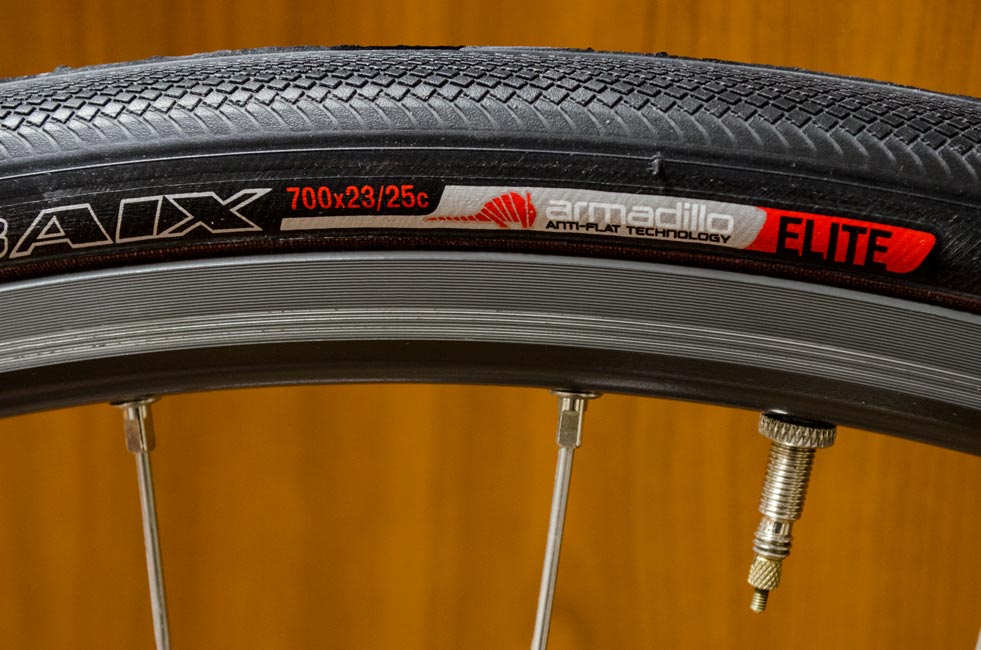
Specialized Roubaix Armadillo Elite

Specialized Roubaix Armadillo Elite tire

To get up into the hills, I ride my bike through glass strewn, broken city streets. Including the weight of my bike, I’m pushing almost 100 kg. I was getting a lot of punctures from very small pieces of glass, frequently enough that I started to consider tire savers. If I hear a crunching sound or ride over small pieces of glass I don’t see in time, I reflexively put my thumb down on the rotating tire to hopefully flick off debris.

Though I need a rear tire that is more resistant to punctures, I also didn’t want to compromise too much on weight because I am riding a racing bike, even though it is from the early 80’s. Years ago, when I lived in Manhattan, I went from tubular tires to a Specialized Armadillo. It was like putting on a truck tire.

After I read Bruce Weber’s account of his flatless cross country bicycle ride with Schwalbe Durano tires, I bought a Schwalbe Durano Plus. With a folding bead, the 700 x 25C tire weighs 380 gm. Compared to the Continental Grand Prix 4-Season (that I was riding in a less demanding environment) the Schwalbe Durano Plus tire had a certain sluggish response.

One of my local bike shops suggested a Continental GatorSkin. They didn’t have the foldable version so I bought the 300 gm, wire bead, 700 x 25C. The GatorSkin felt more responsive than the Durano Plus and through it’s life, I only had one puncture. Unfortunately, the cord started showing in one spot after about 3500 miles.

I would have bought a folding Gatorskin, but LBS #2 wasn’t a Continental dealer. They suggested a Specialized Roubaix Armadillo Elite. I mounted it on my Mavic Open Pro wheel without shredding my thumbs or using tire irons to get the final part of the bead over the rim. Even though it weighs 305 gm, the Elite feels more responsive than the other two tires. For $60, I hope it wears well.

Specialized says, “The Roubaix is an Endurance Road tire for epic rides from smooth country roads to rough field roads.” Since my riding is none of the above, hopefully it will just work.