Solder : Time Watch Kit

Solder : Time™ Watch Kit

This is a SpikenzieLabs Solder : Time™ watch. It uses a a 4-digit 7-segment red LED display that displays the time for about four seconds when the “stem” is pushed in.

There is a CR2032 lithium battery for power, though there is a connection on the circuit board for a power supply. The display could be kept on continuously with a AC/DC power adapter if you wanted to use it as a desk clock (or you could carry around a large battery wired to the watch on your wrist).

The component count is very low – you can see all of them in the photo. The two ICs and the LED module are soldered directly to the board to keep a low profile. The build time for someone familiar with soldering is probably less than an hour. It took me a little longer because I tried to use a yellow LED display module that I ordered from Digi-Key but the digits did not light evenly. The SpikenzieLabs forum suggests that a higher voltage (<5v) might work but I didn’t try it. I unsoldered the yellow module and used the red one.

You should note that this is a big ass watch. A woman’s watch case might be 23-29mm in diameter while a men’s watch case is normally 37-42mm. The Solder : Time case measures ~ 60.8mm (2.4 in). People will notice the Solder : Time on your wrist unless you are the size of Andre the Giant.

The kit sells for $29.95 (USD) but you can also buy an assembled watch for $39.95.

The new, improved version, the SpikenzieLabs Solder:Time II Watch Kit ($59.00 USD) uses the ATmega328P microcontroller and four 5×7 LED matrix modules so you can do even more stuff with it.

MintyBoost 3.0

MintyBoost 3.0
MintyBoost 3.0

I built a pocket size USB charger using a MintyBoost 3.0 USB charger, a 3.7 v, 2600 mAh LiIon battery and a built-in LiIon battery charger in an Altoids Wintergreen Mints tin. It can be used to recharge a cell phone, iPod or other small USB rechargeable device.

I’ve had adafruit.com‘s MintyBoost 3.0 kit and USB LiIon/LiPoly charger (this is v1.1) for a while but I never put them together. I liked the size of the Altoids gum tin of the previous MintyBoost versions I have built but I wanted a little more charging capacity than 2 AA batteries could provide. I wanted a suitable battery and enclosure that didn’t compromise charging capacity and size.

Using ladyada’s calculations for battery power, I decided to use a 3.7v 2600 mAh LiIon battery.

The battery’s capacity:
MintyBoost mWh = 3.7V * 2600 mAh = 9620 mWh input

The amount of current it can provide:
Output mAh @ 5V = 9620 mWh / 5 * 80% = 1539 mAh output (80% is the conversion efficiency)

Number of iPhone 4S recharges = 1539 mAh / 1430 mAh (iPhone battery capacity) ~ 1.1

The MintyBoost kit requires the soldering of a few components to a circuit board. I also made two mods to the internal battery charger. With this version (1.1) of the adafruit LiIon battery charger, removing the resistor R4 and replacing it with a 1K ohm resistor allows the internal battery to be charged at 1000 mA.

The internal battery charger has connections for external status LEDs. I connected current limiting resistors between the board and LEDs, then mounted the LEDs in holes in the Altoids tin. The green LED indicates that the internal battery is charging and the yellow LED indicates a fully charged battery. (LiIon/LiPoly charging tutorial at Adafruit Learning System)

The battery and circuit boards are mounted in the Altoids tin with double sided foam tape. I made a miscalculation in the height of the LiIon charger taped to battery – the cover won’t close when the charging cable for the internal battery is attached.

To charge the internal battery, a USB Mini B plug supplies the power to the internal battery charger as in the photo above. To charge a device, a USB Standard A connector is used. There’s also enough room in the Altoids tin for storing an Apple 30-pin to USB Cable.

MintyBoost 3.0 in Altoids Wintergreen Mints tin

Below are charging test results with an iPhone 4S starting with battery at 49%:

Time (minutes)      Charge (%)
0:00                           49%
0:15                           58%
0:30                           66%
0:45                           75%
1:00                           83%
1:15                           89%
1:30                           93%
1:45                           96%
2:00                           97%

If you are interested in the MintyBoost design process: https://learn.adafruit.com/minty-boost/process

MintyBoost 2.0

Mintyboost 2.0

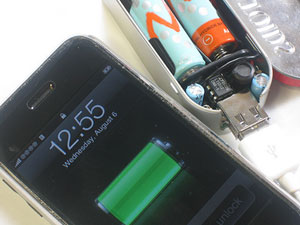
ladyada has updated her MintyBoost battery pack and charger with a higher output step up converter.

She writes, “The upgrade was necessary as the latest Apple products really need a lot of current to charge and hopefully they will work better now!” The MintyBoost uses 2 AA batteries and an Altoids tin for a case.

I’ve built two V1.0 kits and used them to charge a cell phone and my iPod. The MintyBoost is great because it’s small and will give you the additional power to keep your phone or iPod running when you need it.

You can buy the kit and get technical information at ladyada.net

Samsung SCH-i730 Minty Boost

Samsung PCB119UBE

We bought a Samsung USB data cable from Verizon – the rep at the store said it was difficult to get. I thought we could charge our Verizon SCH-i730 with our MintyBoost USB charger. It’s wasn’t that simple.

For some reason, Samsung decided to add another plug in the middle of the cable – so you could plug in your charger! If you wanted to charge your phone while it was plugged into a USB port, you needed the charger. I thought the USB cable was supposed to obviate the need of a charger but Samsung must have a different idea.

I called Verizon tech support and they said that the Verizon stores didn’t even sell the cable. They didn’t tell me much.

Samsung plug in the middle

After opening up the box in the middle of the cable, I traced the +5v from one end to the other. It was obvious that soldering a jumper would enable +5v to charge the phone.

Once the jumper cable was in, I reassembled the connector in the middle of the cable and plugged it into the phone. The phone icon changed to the charging icon meaning that it was being charged by the Minty Boost.

amsung PCB119UBE jumper cable to provide +5v

I looked on eBay, and found there were cables that didn’t need this mod for about 75% less than what we paid for this supposedly difficult to get (according to the Verizon rep at the store) cable.

At least it works.

To get your own MintyBoost charger, that works with iPods, Sony PSP, Nintendo DS/GameBoy Advance, Blackberry and a lot of other devices, go to Adafruit Industries. For a technical overview of the charger, go to ladyada.net.

MintyBoost Case