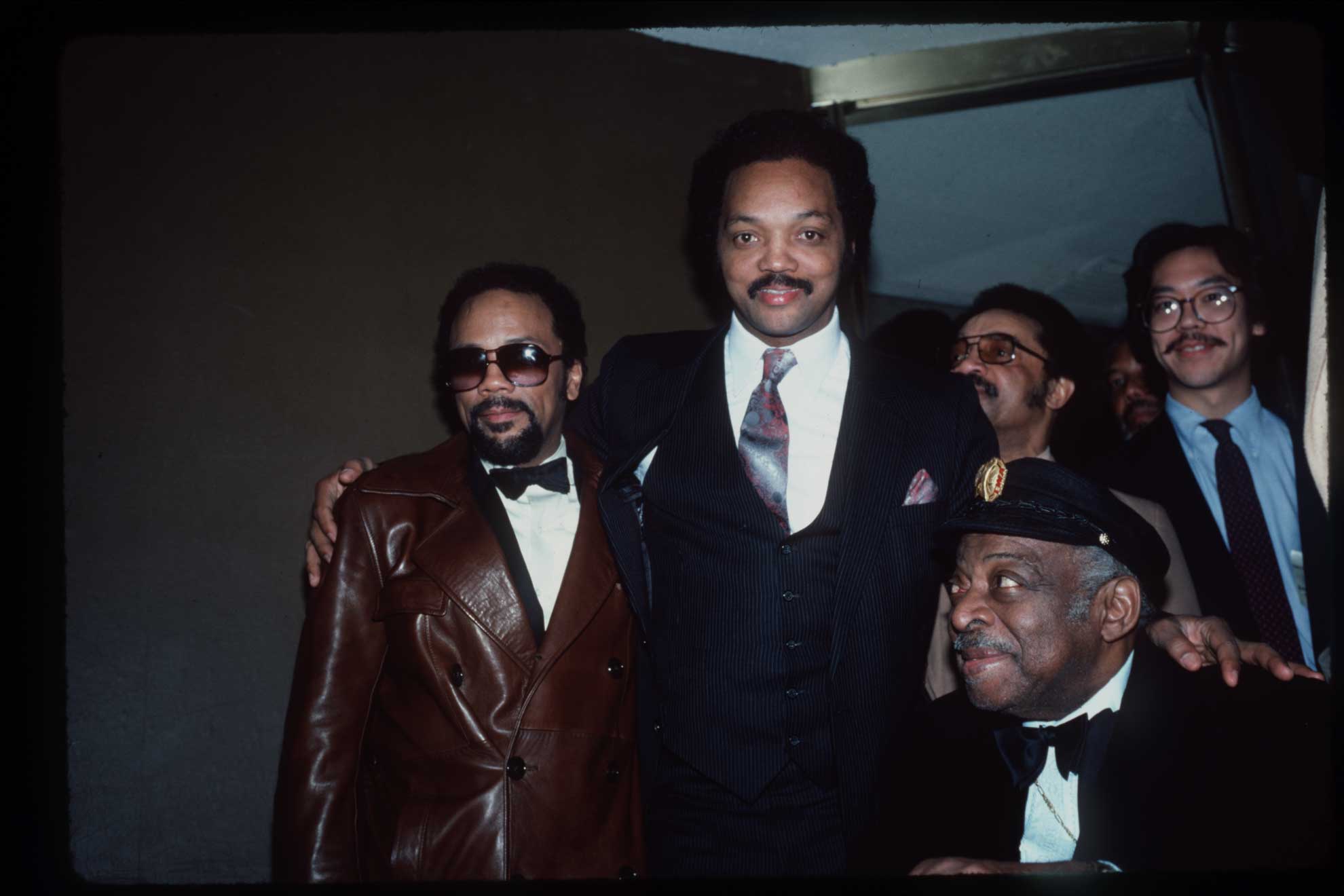
We were in the bowels of 30 Rock. Basie’s entourage was already loaded inside a giant freight elevator. Basie drove in last, on his red electric scooter. I stood there watching the packed group in front of me as the elevator doors were about to close, when Chuck motioned for me to get in, too.
The elevator left us off in the 65th floor’s service area. As everyone walked into the main room, Chuck walked backwards in front of Basie to get a shot. I leaned in for a photobomb.
The rest of the party is a blur, but one moment remains crystal clear. I found myself standing at the end of a small, black lacquer upright piano, watching Stevie Wonder play.
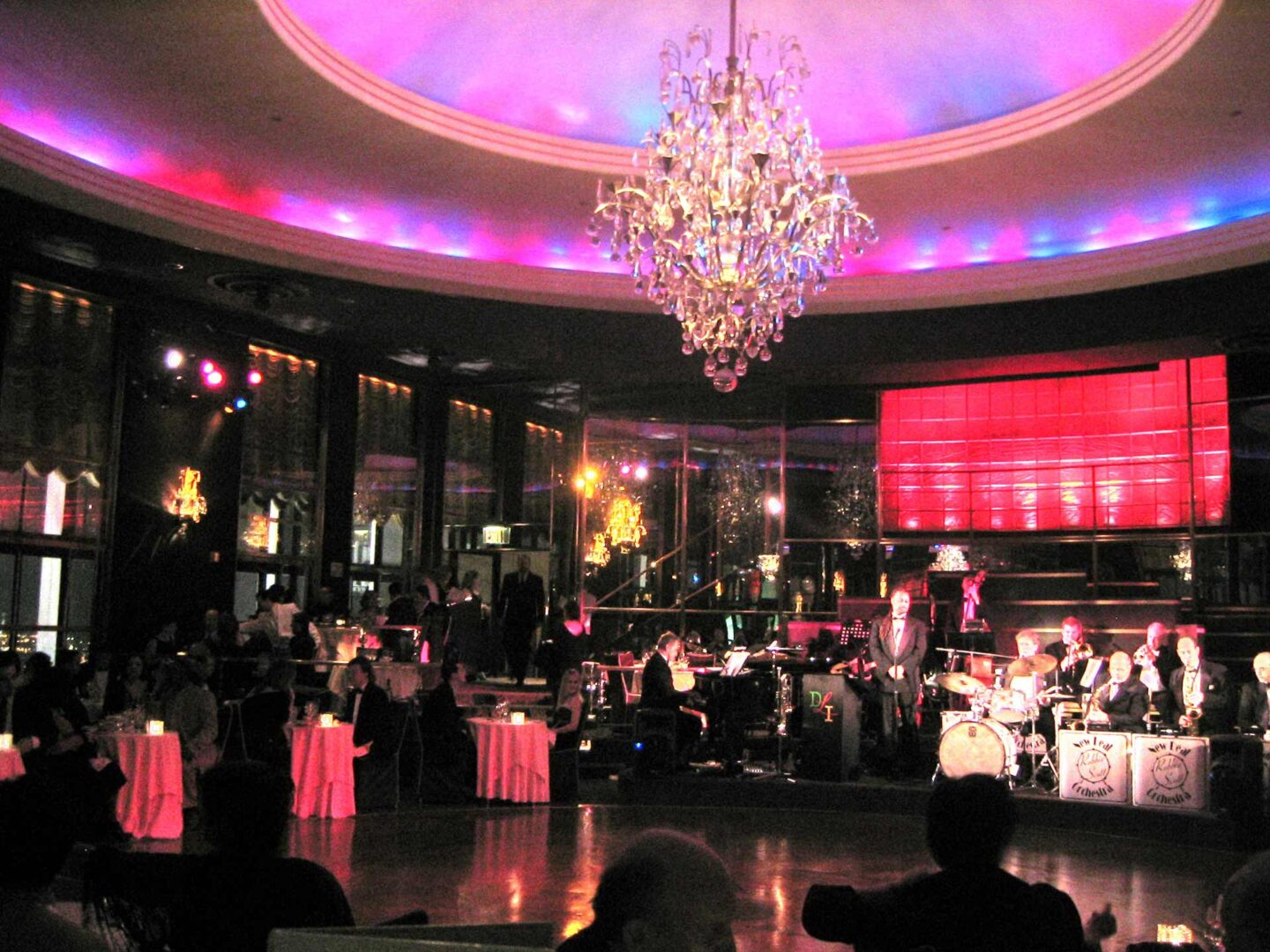
The interior of the Rainbow Room (photographed in 2004). Note: This image is included for atmosphere; it was not taken during the 1979 party. (Public Domain photo by Bradford Schultze via Wikimedia Commons).
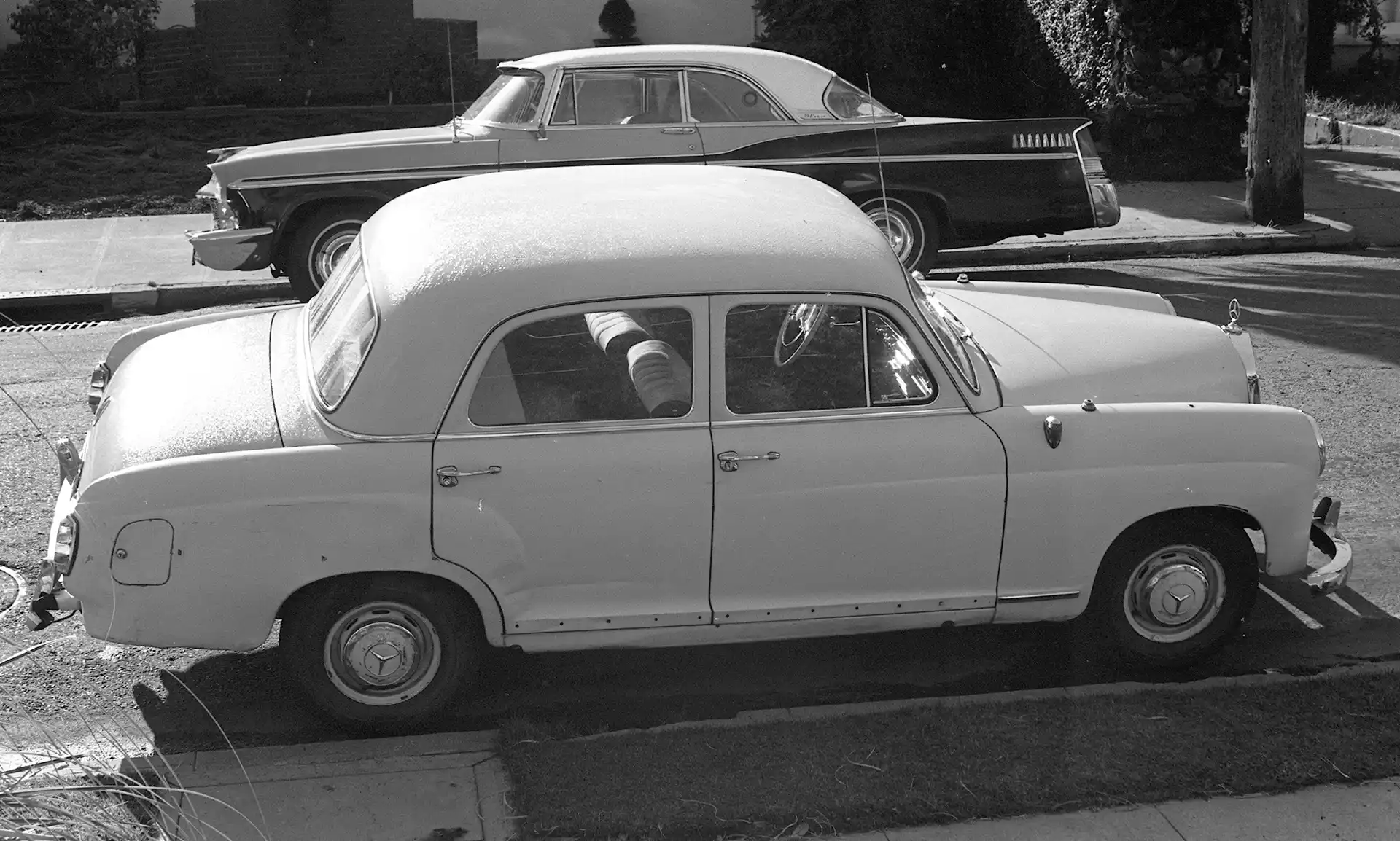
About 20 years ago, at a family reunion, I told some of my cousins that, when I was a teenager, our Uncle John had given me 1959 Mercedes Benz 190. I was in Oakland High School and didn’t even have my driver’s license. They gasped.
My 1959 Mercedes Benz 190 on Calmar Ave – it had a four on the column shifting
That sounds like an extravagant gift from a rich uncle. The reality was that it was from a generous uncle – one Christmas, he literally gave me the shirt off his back when I told him that I liked his Hawaiian shirt. But the car wasn’t running and it was slightly beat-up. It had a few dents, it was missing some rocker panel trim, it was missing a section of the rear bumper and mainly, the car wasn’t drivable. Uncle John thought that there was something wrong with the transmission.
I went to European Motors, then the Mercedes Benz dealership in Oakland, to buy an interior lightbulb. On the counter of the parts department, I saw the first edition of a hardcover book, Glenn’s Mercedes-Benz Repair & Tune-Up Guide. When I flipped through it, I saw photos of a transmission being rebuilt and thought, “I can do that.” That was my introduction to my version wrenching in California in the 1960’s.
Beyond the book, my main source of help was my next door neighbor, Mr Algie. Somehow, we determined that there wasn’t a problem with the transmission. The drive shaft flex joint had failed and the drive shaft was hitting the drive shaft tunnel. He also thought that the low oil pressure and the engine knock was due to worn bearings and rings. The engine needed rebuilding. My solution up to that point was to pour in a can of STP.
I was amazed when Mr Algie showed me how to use Plastigauge, to measure bearing clearances. I learned what scored bearings looked like. And I realized why STP quieted the bearing knock. He also loaned me a lot of the tools that I needed to do the engine rebuild.
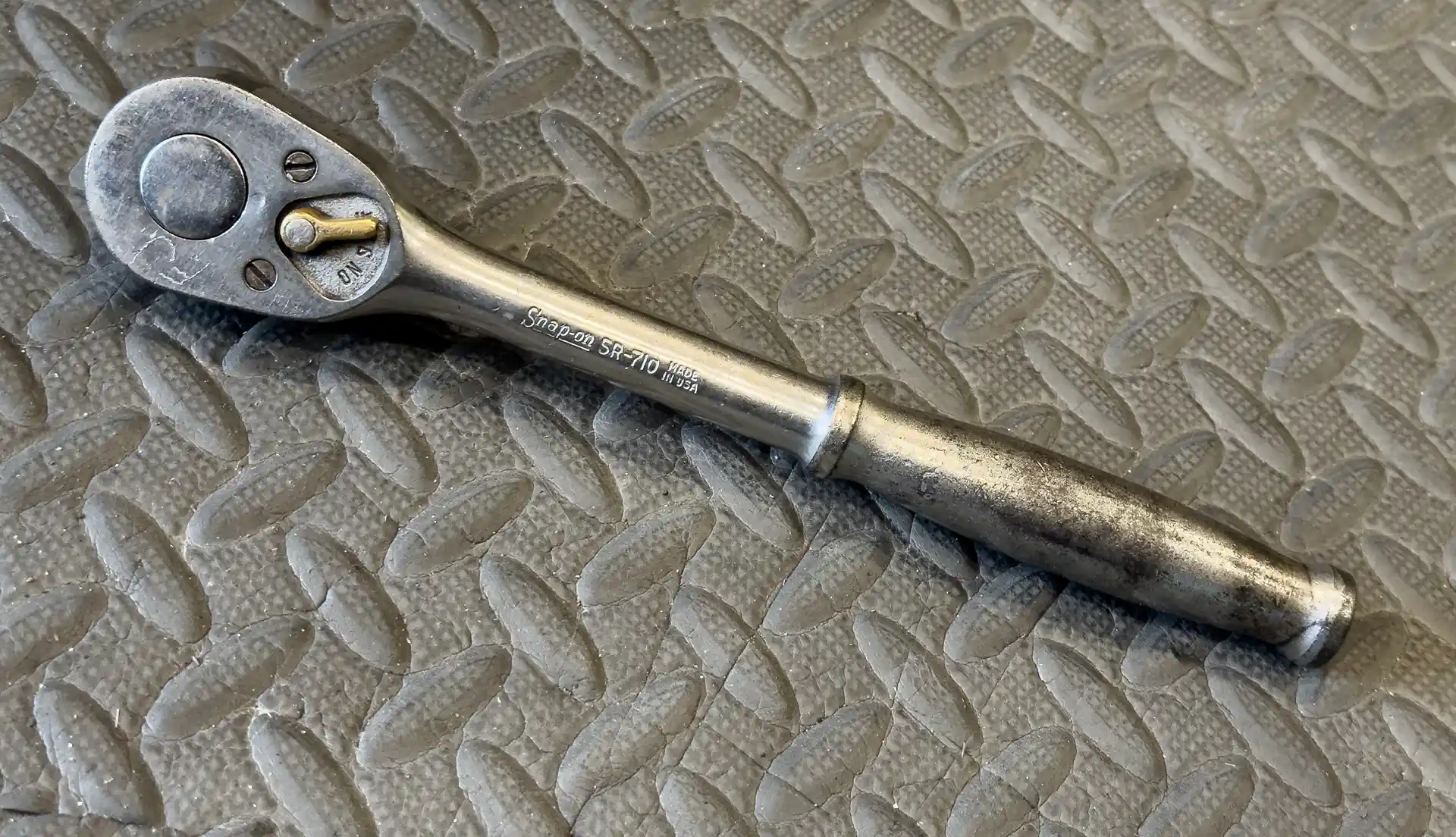
The Snap-on SR-710, 1/2″ Drive Standard Handle Ratchet that I permanently borrowed from Mr Algie 57 years ago. Maybe it was Fritz’s, since it had FJ (Fritz Jarmin) etched into the head.
Eugene also helped me. My parents bought us matching (white!) Ben Davis coveralls (affiliate link) that we wore when we worked on the car.
From what I can remember from working on the car 57 years ago, an interesting design of the 1959 Mercedes Benz 190 was that the engine was mounted on a subframe. After disconnecting the engine plumbing, electrics and mechanicals, there were three big bolts holding the subframe to the rest of the car. After removing those bolts, you could raise the car up and roll out the subframe on the front tires, and then the engine was out – on sort of a rolling work stand.
The problem was how to get the car high enough to roll out the subframe. Uncle John had made two ramps by crisscrossing 2x4s. They were a little less than a 18 inches high. Somehow, Eugene and I used ropes and two bumper jacks on the wooden stands to raise the car high enough to get the subframe out. I can not imagine why I was doing this, but after the subframe was rolled out, I was standing inside the engine compartment and the car fell off the jacks. Miraculously, I was untouched. There could not have been a more dangerous operation.
I was lucky that I was able to have the car to drive to Oakland High School. After the hood ornament was stolen, I made an alarm that activated the car’s horn when someone moved the hood ornament. Of course there were times after school when I’d come back to my car and the horn was honking.
I even drove it to go skiing in the Sierras – probably to Sugar Bowl – a 6,883 ft (2,098 m) climb. I wasn’t particularly mindful of how powerful the engine was, but I remember on one trip, it was so slow going up a hill we stopped so I could try something. I thought that by rotating the distributor to change the ignition timing we’d get more power.
(Some specs of the 1959 Mercedes Benz 190 (W121) have it at a curb weight of 1200 kg / 2646 lb and 84 HP)
When it was time to move on to another car, I said good-bye to the 190. I wanted something that was silver and had a 5 speed transmission. In 1970, there weren’t many affordable cars that fit that latter description. I got lucky and found a used 1967 Alfa Romeo Giulia Sprint GT Veloce (‘step nose’ ). It’s another one of the cars that I wish I had today.
When I was 10 or 11 years old in the early 1960s, one of my best friends, Scott Simonds, lived about 2,565 feet away from my house on Calmar Avenue. Scott lived Mandana Blvd, just below Ashmount Ave. That distance was significant because I thought that the Knight Kit C-555 Superhet Walkie Talkie Transceiver Kit would be a great way for Scott and I to keep in touch.
The 1964 Allied Radio catalog (page 2) said that the walkie talkies had a 3/4 mile (~1.2 km) operating range with their 100 mw input. (Currently in the U.S., FRS – Family Radio Service – has a 2 watt maximum)
Page 2 of the 1964 Allied Radio Catalog showing the Knight Kit C-555 Superhet Walkie Talkie Transceiver Kit
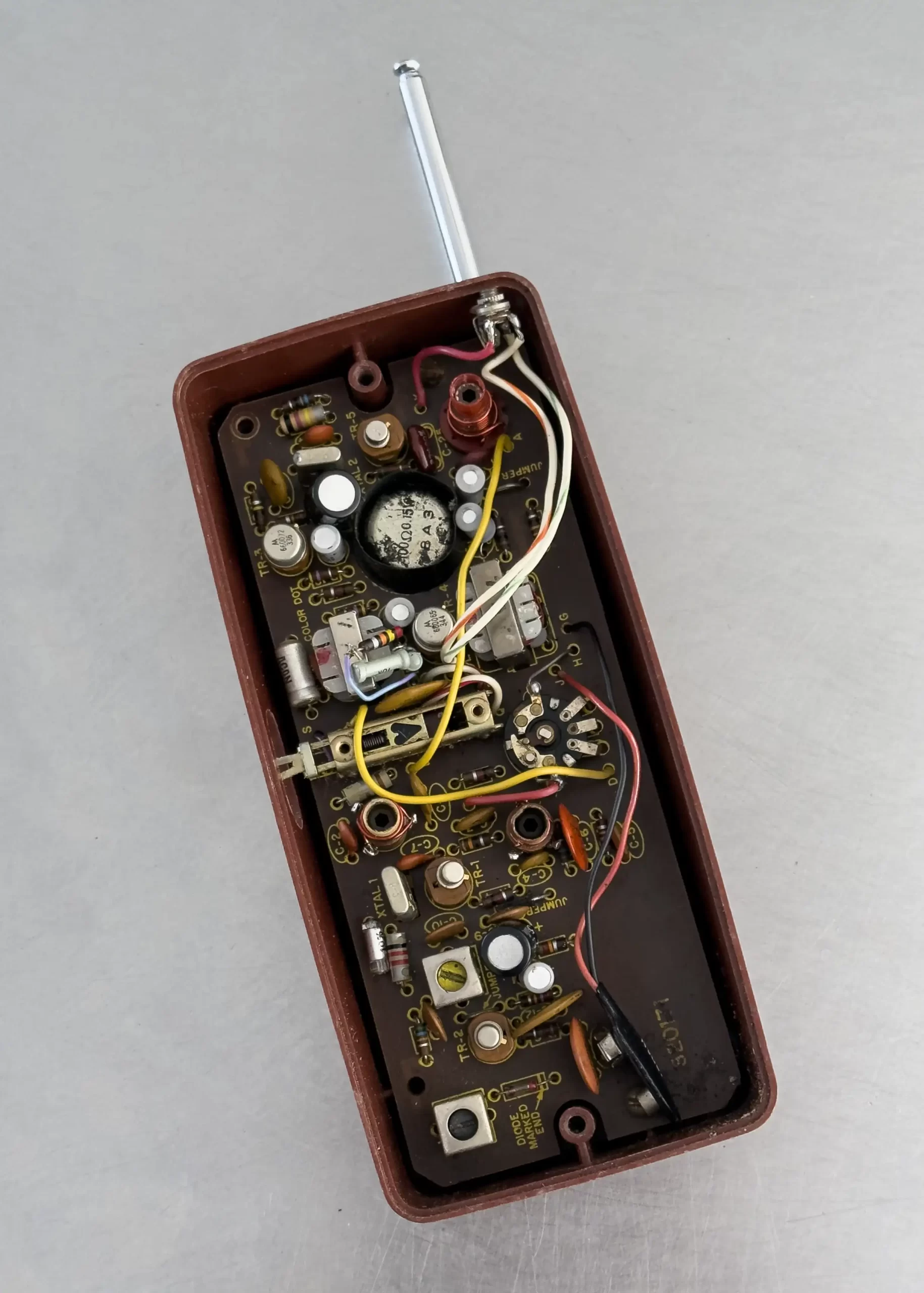
I thought that I could build the kit because, my father, for some reason, owned a Weller Junior Model 8100 Soldering Gun. After soldering the components to the circuit board, the walkie talkies didn’t work. Unfortunately, troubleshooting the kit was a little beyond the my capabilities when I was 11 years old. Fortunately, my Uncle Jimmy went through them and he got the C-555 walkie talkies talking to each other.
What my Knight Kit C-555 Superhet Walkie Talkie Transceiver Kit with rear cover removed showing electronic components looks like on May 17, 2025
One modification that I made was to replace the battery connectors with the common PP3 9V Battery Snap Connectors. The original design used a PP4 (Eveready 226, NEDA 1600) cylindrical 9V battery with a snap connector at each end. (see Joe Haupt’s flickr photo)
The ironic thing about this is that I don’t recall ever actually talking to Scott using these walkie talkies from my house to his.
For some reason, 61 years later, I still have both of these walkie talkies in my possession.
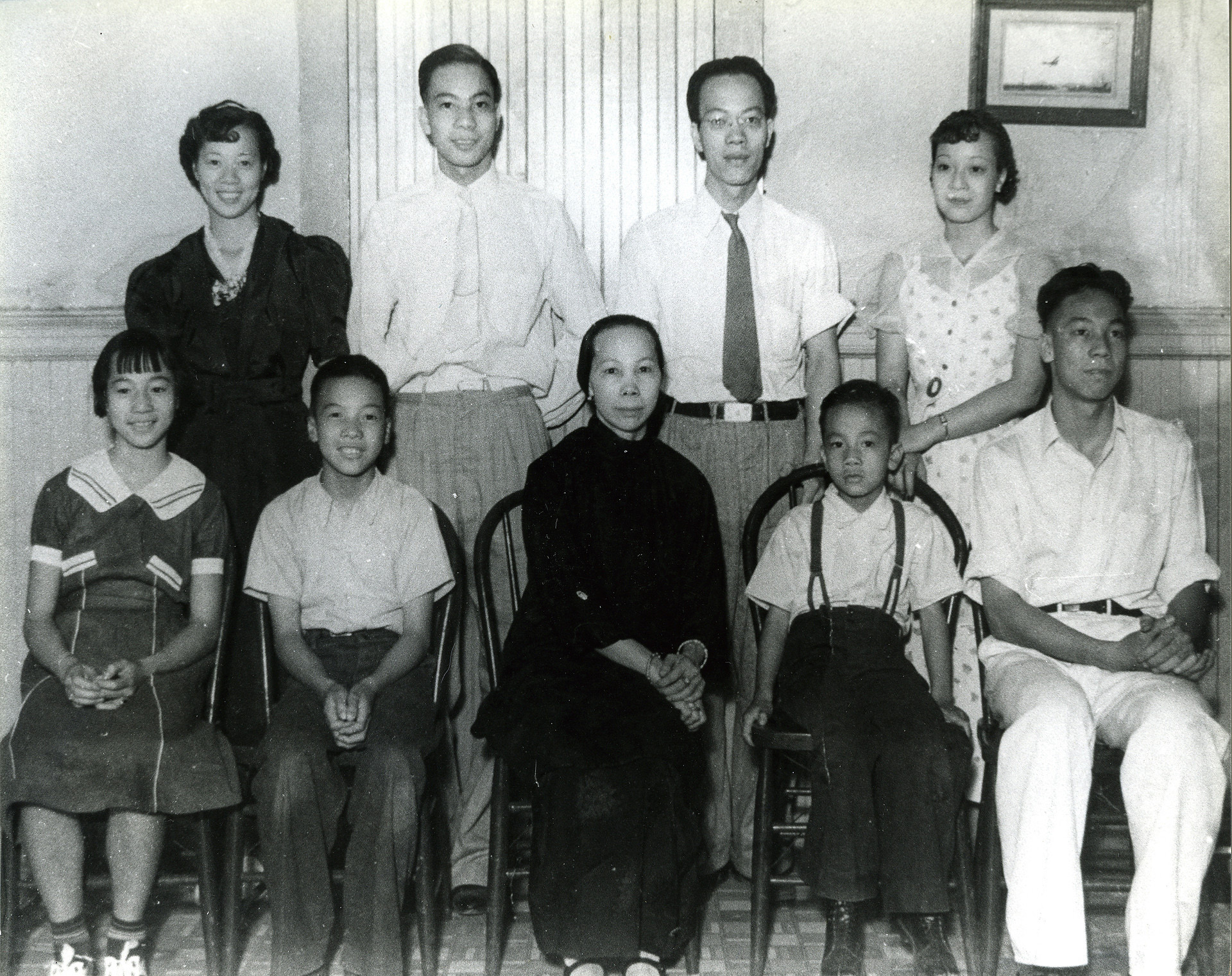
I grew up in Oakland, California, in the 1950s and 1960s, on Calmar Avenue. The house we lived in had been in my father’s family since the early 1940s. I only know this because my Uncle Jimmy once told me that what was then my father’s den used to be his bedroom. I never knew if any of my father’s other brothers and sisters lived in the house.
My paternal grandmother, Mok Shee Wong, and her children. Back row from left: Frances Lee , Joe Wong, Honki Wong (my father), Flora Lee. Front row from left: Rose Jan, Jimmy Wong, Mok Shee Wong, Robert Wong, John Wong.
The foot of Calmar Avenue begins at Mandana Blvd, a little east of the beginning of the Lakeshore shopping district. The street is narrow and steep in some places as it rises 180 feet along a ridge. It’s a hilly neighborhood. Our part of Calmar plateaued in a group of about 15 houses, with downslopes behind the houses on either side towards Santa Ray Avenue or Balfour Avenue. It was a good place to learn to ride a bike because it was level. My sister and I would ride our bikes down to King Narcisse’ driveway and turn around.
Our House: Then and Now
Today, in real estate terms, the house is described as a 4 bedroom, 2 bath, 2500 sq ft property. In my childhood reality, it was a 3-bedroom house. There was a bedroom for my parents, one for my sister Alberta, and one for me.
We all shared a single bathroom located on the second floor. The downstairs bathroom served as our laundry room. I don’t think it was properly plumbed as the washing machine’s drain hose simply hung over the edge of the bathtub. You had to carefully step over it to reach the tiny sink. Off the back hallway, there was a separate small room – a “water closet,” which housed the toilet. Behind the toilet, about eight feet from the floor, there was a small window that was hinged from the top that opened to the roof of the garage.
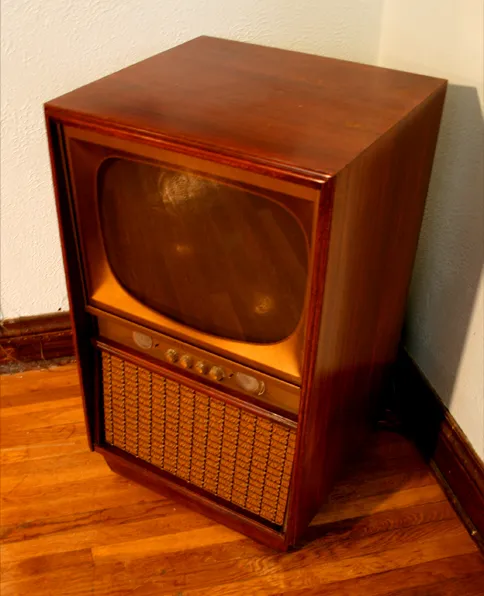
We had a Magnavox Black and White Television sort of like this (photograph courtesy of Leo Kemph)
At one time, our TV was downstairs in the living room. It was a Magnavox, similar to this one, but with a lighter finish. I still own the cabinet, because one of my mañana projects is to stick a display in it, maybe driven with a Raspberry Pi.
I also remember that the TV was in the living room because during a fairly big earthquake, I was playing in front of the TV. I was about 4 ½ years old and my father told me to get under the dining room table. The dining room chandelier was swinging, but I remember that I wasn’t very scared.
When we got a color TV, we moved our TV viewing to a room that spanned the entire width of the second floor in the back of the house. At one end, we had the sofa, coffee table and television, and at the other, my mom had her desk.
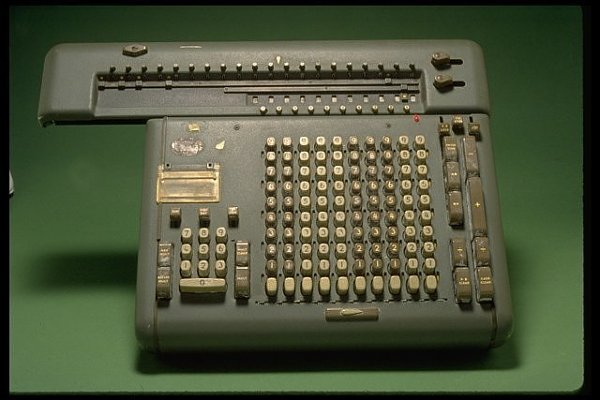
On the ground floor, between the foyer and the back hallway, my dad, Honki L. Wong, had an office. Because he was an accountant, he had an amazing electo-mechanical Friden calculator on the center of his desk and another adding machine to the side. @CuriousMarc has a page dedicated to the Friden STW 10. As a kid, I remember using it, just to listen mechanical noises that accompanied a simple calculation. I also remember now knowing what I was doing and jamming it to the point where a service call was needed.
Formica® Laminate 6942 Charcoal Boomerang
Sometime in the 1950s, my parents had the kitchen remodeled. It featured white painted steel cabinets and grey Formica® countertops with a mid-century Charcoal Boomerang (6942) pattern. Our stove was a 1950s Wedgewood, complete with a griddle. On the rare occasions that we made pancakes using the griddle, I learned that they were ready to be flipped when a certain number of bubbles appeared in the uncooked batter.
The narrow garage attached to our house had room for just one car. A wall separated it from a second, smaller room within the garage. Over the years, the concrete floor in the back part of the garage developed cracks, because of earth movement. There was an empty lot on Balfour Avenue behind our house and there has never been a house built there.
The Neighborhood and some of the Neighbors
A driveway ran along the east side of our house, immediately adjacent to the Algies’ driveway, though theirs was a couple of feet higher than ours. Our neighbors on the other side were the Taylors. They had three sons.
John Algie owned a machine shop and was a car collector. He owned some impressive cars, including a 1937 Mercedes Benz 540K Cabriolet, a Facel Vega, a Packard and a BMW Isetta (among others), that rotated through their driveway. Mr Algie used to start the 540K on weekends. The supercharged, straight eight engine sounded like a frantic, electric eggbeater to me. Once, Mr Algie took me for a ride in the 540K down to Lakeshore. The two toned, black and ivory paintwork had running boards with spare tires mounted on them. Two gigantic exhaust pipes exited out the right side of the engine, plunged down into the running boards and made a long trip to the twin exhaust tips at the rear of the car.
The Algies’ daughter Joanie, used to babysit me. They also had a black dachshund named Freddie, that I liked to play with. At the side of the house, they had a doggie door that I was able to crawl through. I guess when I was little.
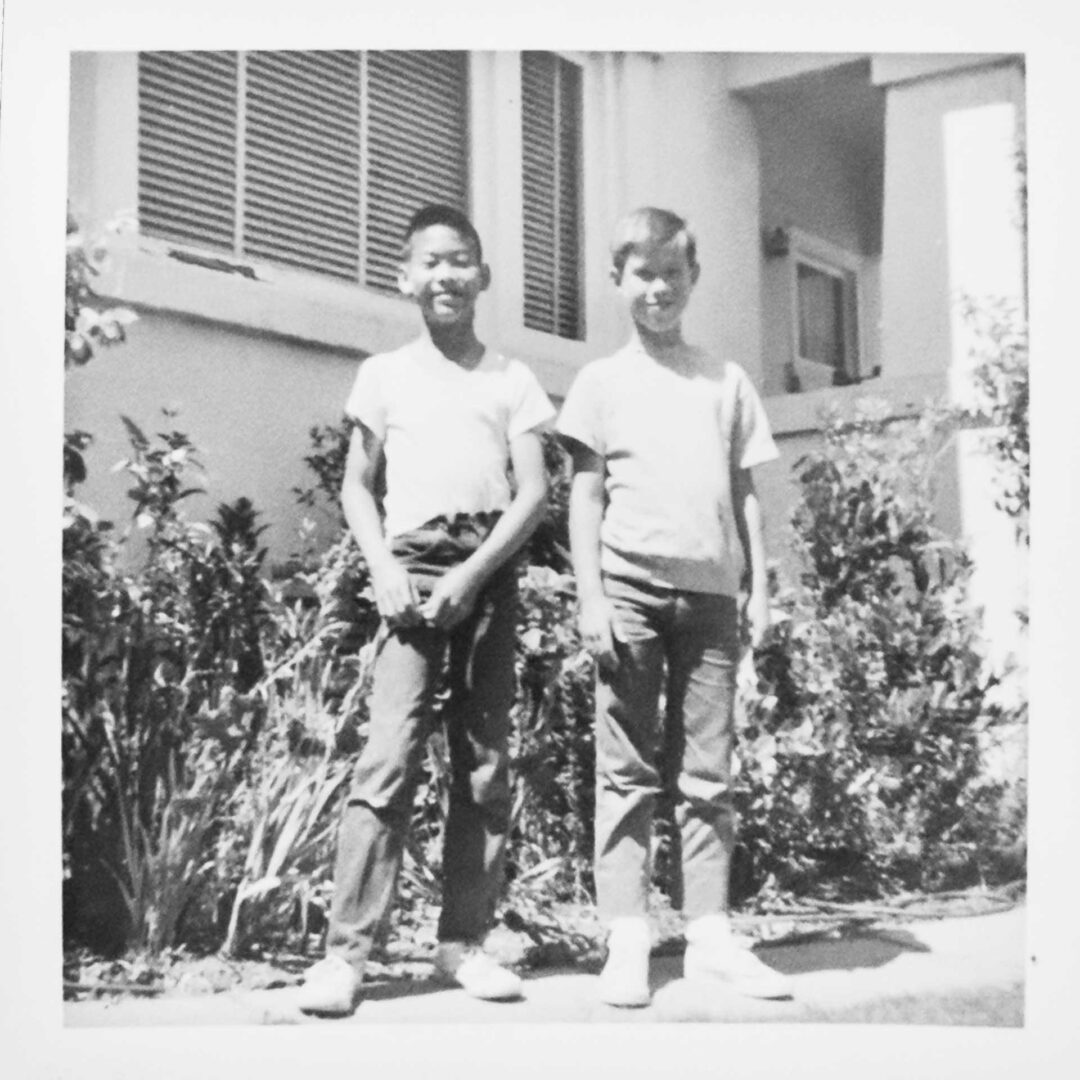
Leslie Wong and Bruce Baxley, June 1964 in front of 778 Calmar Avenue, Oakland, California
There were only a few kids my age living on our stretch of Calmar. I occasionally played with Mark Johnson, who lived three houses up, but he wasn’t a school mate because he went to a Catholic school. I went to the public elementary school, Crocker Highlands School. The close friendships I made at Crocker Highlands were with kids who lived blocks away.
The Duhes lived down the street. Since the kids also went to a Catholic school, I didn’t have much interaction with them even though the eldest son Philip, was my age.
At the very top of the hill resided the Cliftons; Joel and Sammy were older, though their French poodle, Bonjour used to roam the street.
Down the street, King Narcisse had a Rolls Royce and several Cadillacs. He owned a third generation Cadillac Series 62. I remember it because it had a hidden fuel filler that was accessed by flipping up the left tail light on the fin. King Narcisse had a red carpet rolled out for him when he made an entrance into his house. In 2021, Philip Duhe wrote a Facebook post about it.
To provide the best experiences, we use technologies like cookies to store and/or access device information. Consenting to these technologies will allow us to process data such as browsing behavior or unique IDs on this site. Not consenting or withdrawing consent, may adversely affect certain features and functions.
Functional
Always active
The technical storage or access is strictly necessary for the legitimate purpose of enabling the use of a specific service explicitly requested by the subscriber or user, or for the sole purpose of carrying out the transmission of a communication over an electronic communications network.
Preferences
The technical storage or access is necessary for the legitimate purpose of storing preferences that are not requested by the subscriber or user.
Statistics
The technical storage or access that is used exclusively for statistical purposes.The technical storage or access that is used exclusively for anonymous statistical purposes. Without a subpoena, voluntary compliance on the part of your Internet Service Provider, or additional records from a third party, information stored or retrieved for this purpose alone cannot usually be used to identify you.
Marketing
The technical storage or access is required to create user profiles to send advertising, or to track the user on a website or across several websites for similar marketing purposes.