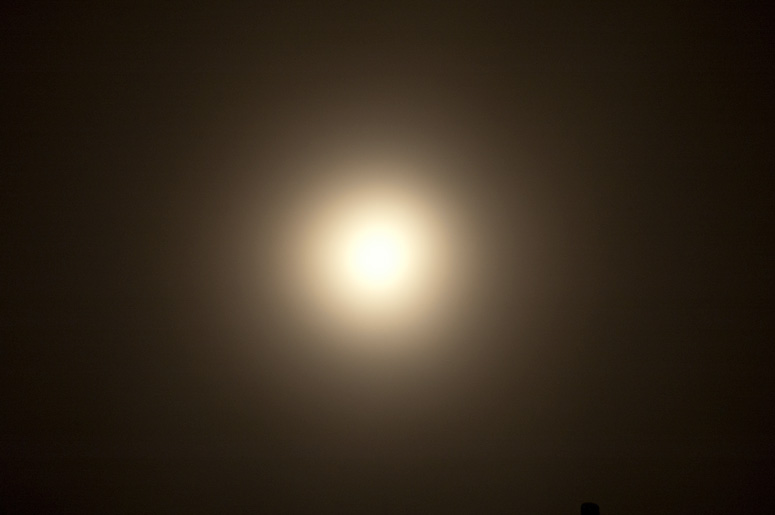
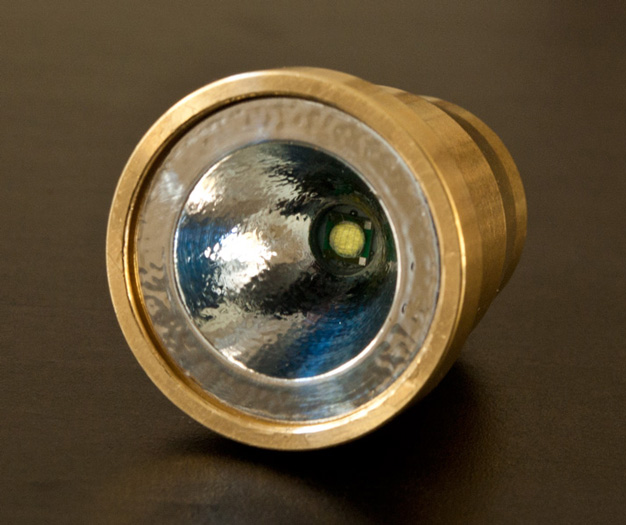
The beam from my Veleno Designs E-Series LED drop-in my Surefire E2E had a green tint. I replaced it with a neutral tint Cree XP-G LED and the beam still had a green tint. Some people commented that the green tint was caused by the stock Surefire reflector.
Krylon Metallics Bright Silver (1401) paint
Instead of buying a new E2E head, I removed the factory reflective coating on the head with solvent and tried using “chrome” paint to re-coat it. The Krylon Metallics Bright Silver (1401) paint was not reflective enough to be used as a flashlight reflector. With the E2E reflector six feet away from a white wall, the bulb just threw a giant white circle with no hot spot.
Mona Lisa Silver Leaf
Next I tried Mona Lisa Silver Leaf. The leaf material comes in booklets of 25 (5.5″ x 5.5″) sheets. I used Gold Leaf Adhesive Size on the E2E head before applying the leaf. The size is a water-based adhesive that dries to a light tack before the leaf is applied.
The silver leaf is so thin that picking up part of a sheet will tear it. I just tried to get a large enough piece to cover the reflector then I burnished it lightly. There were some creases in the leaf, but since I wasn’t trying to get an absolutely mirror finish, the imperfections weren’t a problem. The reflector with the silver leaf has a nice hotspot. I’m not sure how the size (adhesive) will hold up to the heat.
A year ago I saw this Youtube video where Steve Dahl at DigiKey demonstrates a method of soldering high-brightness LEDs to a Metal Core Printed Circuit Board (MCPCB) using a heat gun.
I don’t have an expensive heat gun – just one for removing paint. I thought if I used my infrared thermometer, I could measure the temperature at the tip of the gun and when it was maintaining the correct temperature, I would hold the board/LED in the heat.
I put dabs of solder paste on the contact pads where the LED would be soldered and placed the LED on the pad. It doesn’t need to be precise because the solder will only flow onto the contact pads.
The Cree XP-G specs (PDF) have 215 degrees C (~419 degrees F) for Peak/Classification temperature. When my thermometer read that, I put the board in the heat. (In the video, they use 600 degrees, which seems way out of spec and may be the reason the board turned brown). In a few seconds the paste melted and the LED centered itself, just like in the video. I immediately turned the heat off and kept the fan running to cool the board.
In the photo, the bottom board has been soldered. The upper left board shows the amount of paste I used. The upper right board has the LED on it before soldering.
Before I reassembled the drop-in, I wiped some hazing off the reflector with some chrome polish and inadvertently removed some of the reflective finish. I needed a new reflector.
Modded Malkoff M61 and McR-20 Seoul reflector
I searched for reflectors for the Cree XP-G and found positive comments about Don McLeish’s McR-20 Seoul reflector. I ordered one from the Sandwich Shoppe and it was delivered in 2 days.
There is a recess around the top of the M61 heat sink that the top of the stock reflector sits in – that’s the flat part of the reflector. I put a GITD (Glow In The Dark) O-ring in the recess and it held the McR-20S reflector perfectly. The new LED is mounted on a thinner circuit board than the Malkoff board, which in this case helps with the reflector placement. The bottom of the reflector (with a thin insulator) rests on the LED board. The other end of the reflector is flush with the end of the heat sink.
The beam is very nice. Compared to a M60 or M30, there is less of a hot spot and more spill. The stock M61, IIRC, didn’t have as much of a hot spot compared to the McR-20S.
So far in this mod, I have destroyed the Malkoff M61 driver board and damaged the reflector. But now I’m happy with a drop-in that has a great heat sink, a great beam and three modes. It’s now in my current favorite flashlight, the Surefire C2.
I received my Malkoff M61 drop-in last week. The drop-in uses a Cree XP-G LED and it’s designed to replace the lamp assembly in Surefire 6P style flashlights. Malkoff Devices says, “the output is approximately 260 measured out the front lumens.” It is a single mode drop-in.
I bought the M61 with the intention of modding it with the Shiningbeam three-mode regulated circuit board (NLA). The Cree XP-G had recently noted an “increase of maximum forward current to 1500 mA for XLamp XP-G Cool White is retroactive and applies to all XLamp XP-G Cool White LEDs produced by Cree. The increase is the result of more extensive qualification testing that was performed after the initial product launch.” The Shiningbeam board output current is 60 mA on low, 440 mA on medium and 1.4 A on high.
First, I removed the potting and contact spring. In the process, I destroyed the Malkoff driver board. I used a Dremel to reduce the diameter of the Shiningbeam board so it would fit inside the drop-in.
Modded Malkoff Devices M61 Drop-in
The Shiningbeam board works as advertised – I measured 1.4 A on high, 450 mA on medium and 65 mA on low. I’m not enamored with the yellow-green tint of the LED; maybe I’ll replace it down the line.
I have also used the Shiningbeam board in a DealExtreme XP-G R5 drop-in (SKU 32954). The result, compared to the Malkoff, is a little more throw and a lot less spill. The tint of the DealExtreme LED is also cooler – more blue.
After disassembling the M61, it’s clear that this is a most robust, superbly constructed drop-in. I can see why a professional would be able to rely on this drop-in in a life or death situation. But flashlights for me are a hobby, which is why I wanted to mod this drop-in to have (a more useful for me) three modes. (Note: Malkoff Devices now makes a three mode M361 P60 style drop-in that has an input voltage of 3.4-6 volts)
You’d think a 3D cell Maglite would be pretty bright. It’s over 12.5″ (310 mm) long and weighs over 30 oz (850 g) with batteries. With the standard Krypton bulb, the 3D Maglite puts out about 76 lumens. A flashaholic wants 76 lumens from a keychain light.
The Maglite may be behind in bleeding edge illumination technology, but flashlight modders like them because it’s a great platform to build upon. One of my first mods was the Roar of the Pelican – a 2D Maglite running on 6AA batteries and a high wattage bulb. It puts out about 600 lumens.
3D Cell Maglite with Malkoff Drop-In Module
There are many LED Maglite mods that will put out a lot of light. Multi-chip LEDs – the Cree XLamp MC-E, Seoul Semiconductor Z-Power P7 and the Luminus SST-50 and SST-90 PhlatLight LEDs are popular because of their high outputs. You just need a heatsink for the LED, a driver and suitable batteries in a combination that won’t burn up any of the components. A lot of people have figured this out for you. Google.
I decided to do the easiest high performance 3D cell Maglite upgrade: Malkoff Devices’ Maglite drop-in with the Cree XP-G LED. It’s not as bright as a multi-chip LED mod, but the Malkoff drop-in uses regular alkaline D cell batteries and it has a six hour runtime at full output. The only problem with the Malkoff drop-in is that it’s difficult to buy because it’s so popular. Once they are in stock, they sell out quickly. Malkoff Devices back-in-stock email notification system will alert you when they’re available, but even then you have to be fast.
Installation is simple: remove the existing bulb, push the drop-in down as far as it will go inside the flashlight and tighten the screw (which wedges the drop-in’s heat sink against the flashlight body). The bottom part of the reflector needs to be cut off to accommodate the drop-in. This is a simple cut with a razor saw. If that is too much for you, Malkoff Devices sells a pre-cut Maglite reflector for $12.99.
Malkoff Devices description: “This dropin produces a real 260 (measured out the front) lumens in a 2D or 3D light with alkaline batteries. The Drop-In module is constructed of CNC machined structural aircraft aluminum and has a regulated driver. Full heatsinking of the driver and LED insure that the module can, and will, run at maximum output for extended periods. It will easily illuminate objects at a distance of 1000+ feet and will light a 2 inch red reflector at a distance of more than 1/4 mile. If you shine someone with this at night, within a 100 ft radius, they should see spots for a good 8-10 seconds.“
Manage Consent
To provide the best experiences, we use technologies like cookies to store and/or access device information. Consenting to these technologies will allow us to process data such as browsing behavior or unique IDs on this site. Not consenting or withdrawing consent, may adversely affect certain features and functions.
Functional
Always active
The technical storage or access is strictly necessary for the legitimate purpose of enabling the use of a specific service explicitly requested by the subscriber or user, or for the sole purpose of carrying out the transmission of a communication over an electronic communications network.
Preferences
The technical storage or access is necessary for the legitimate purpose of storing preferences that are not requested by the subscriber or user.
Statistics
The technical storage or access that is used exclusively for statistical purposes.The technical storage or access that is used exclusively for anonymous statistical purposes. Without a subpoena, voluntary compliance on the part of your Internet Service Provider, or additional records from a third party, information stored or retrieved for this purpose alone cannot usually be used to identify you.
Marketing
The technical storage or access is required to create user profiles to send advertising, or to track the user on a website or across several websites for similar marketing purposes.