Phil Wood Spokes

Phil Wood spokes, Campagnolo 8 speed hub

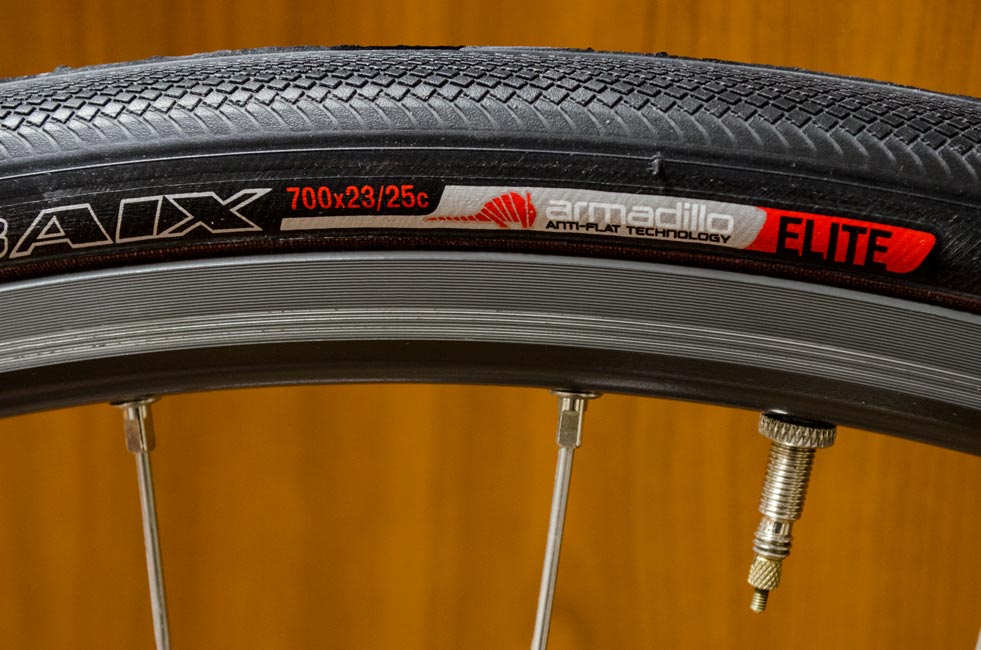
When I went to Montano Velo to buy some spokes and a rim for a new wheel build, they sold me Phil Wood spokes. I bought double butted spokes, so it took a few minutes to prepare them on the spoke machine. I had always used DT spokes and I really didn’t notice that they weren’t DT spokes until I started threading them through the hub and saw “PHIL” embossed on the butted section near the spoke head. I used Damon Rinard’s free spoke length calculator, which is an Excel spreadsheet with macros, to calculate the length of spokes that I needed. After truing and dishing the wheel, the spoke length calculations proved correct.

I also used a Mavic Open Pro rim. The Mavic Open Pro rims have double eyelets, which hopefully distribute the stresses through the two sections of the rim. I considered the Mavic CXP33, which has more of a V-profile than the Open Pro. I guess I’m a traditionalist. I’m not interested in saving weight – I just need strong wheels that will hold up to someone who weighs 13.8571 stone and occasionally bunny hops on craggy Oakland streets. I have never had any problems with Mavic rims. In the past, I have used the G40, GP3, GP4, MA40 and MA3. On my first ride today, the wheel didn’t pretzel so I guess it’s working.

Camera: Nikon D7000. Lens: Nikon Micro-NIKKOR 105mm f/2.8 (lens gift of Joe McNally)

Modifying a Campagnolo Cog

Grinding the splines on a Campagnolo 10 speed compatible cog

After building a new wheel and acquiring a new 13-26 Campagnolo Record 8 Speed Ultra Drive cassette, I needed to change the cog in the final position from a 26 tooth to something larger so I could have a lower gear for hills. My normal ride has a Category 3 climb, according to the Tour of California’s rating of bike climbs. There is also a short 9.5% grade that I dread every time I get there, so the extra 2.6 gear-inches makes a difference.

I couldn’t find an 8 speed Campagnolo cog larger than a 26 tooth but there seemed to be Miche (Campagnolo 10 speed compatible) cogs with 27, 28 and 29 teeth for sale on eBay. According to every source I found, Campagnolo 10 speed cogs would not work on an 8 speed hub, mainly because the splines are deeper and there is a stepped-ridge on one of the splines. That’s where the Dremel cut-off wheels come in. After a few minutes with the cut-off wheel and some chamfering of the splines with a file, the 10 speed cog was now 8 speed compatible.

Campagnolo Record Hub

Cracked Campagnolo Record Hub with hairline crack

Mavic Open Pro CD rim with Campagnolo 8 Speed Hub

I have been using Campagnolo Record hubs since the I started buying Campagnolo components in the early 80’s. When cassette hubs were introduced, I stayed with freewheel hubs because of the 126mm drop out spacing on my De Rosa.

I’ve also been using a Shimano Dura Ace (Hyperglide) freewheel because of its good availability. The center to center spacing (5.0mm) and the thickness of the cogs are very similar to the early Campagnolo 8 speed according to Sheldon Brown’s Bicycle Frame and Cassette Spacing Crib Sheet. The Shimano freewheel also works very well with the Campagnolo Record Syncro downtube shift levers that I use with a 7 speed insert.

This was all fine until the rear hub developed a hairline crack at one of the spoke holes. Instead of buying a used Campagnolo freewheel hub, I decided to find a used Campagnolo 8 speed hub. This seemed the most economical route as opposed to buying new Campagnolo Ergopower controls, a new rear wheel with a Campagnolo Record hub, new 10 or 11 speed sprockets and a new derailleur.

The 8 speed hub I bought on eBay had clean bearings and races when I disassembled it so I just cleaned everything up and added new grease. I bought a Mavic Open Pro (CD) rim and laced it up this afternoon. I managed to buy a new Campagnolo Record 8 Speed Ultra Drive cassette on eBay so my 30 year old De Rosa is back in business with a 20 year-old shifting system.

Sunita Williams Gives a Tour of International Space Station

Shimano pedals on the ISS exercise bike
closeup of Shimano pedals on the ISS exercise bike
Nikon cameras and lenses on the ISS

Sunita Williams gave a video tour of the International Space Station a few hours before her return to earth on November 18, 2012. I found it fascinating because her tour gives a great sense of the layout of the interior of the ISS and what it actually looks like. Also, in a weightless environment, the meaning of up and down have different definitions.

There were a couple of things that were especially interesting to me. When the crew uses the exercise bike, they don’t need a seat because they don’t sit down. They use clip-on pedals to hold them to the “bike.” The pedals look very similar to the Shimano road pedals that I use on my De Rosa. The exercise machines need to be isolated from the walls of the space station so they don’t put any forces into the structure of spacecraft and solar arrays.

When Commander Williams entered the Russian segment where Service Module Central Post of the space station is located, there was a nice assortment of Nikon photography equipment on both walls.